Treating facial nerve paralysis
I recently experienced integrative care for my own health, which has reinforced my passion for it as the best approach to healthcare. What happened?
Driving into town, my speech felt strange, and when I glanced at my reflection in the mirror, the right side was drooping. I’ve been a vet for a long time, so my instinct is always worst-case scenario, and I detoured via the ER. After blood tests, ECG, MRI and CT in quick succession,
I was relieved to be told that instead of a stroke, I had Bell’s Palsy.
What is Bell’s Palsy?
Bell’s Palsy is a common cranial neuropathy of the facial nerve or its branches, leading to sudden facial muscle paresis or paralysis. Symptoms may progress over two to three days, and include a drooping eyelid or difficulty closing one eye, difficulty smiling, drooping of one side of the mouth, difficulty eating and drinking, drooling, neuropathic pain and possibly a headache, loss of taste, a dry mouth and dry eyes.
The cause may be viral, such as Shingles, but is often unknown. I was prescribed a week of prednisolone, an eyepatch and some lubricating eye drops. With my eye patch and slurred speech, I felt like a pirate.
After one week, my symptoms had not improved. The neuropathic pain kept me awake at night and my blurred vision made driving a challenge. So, I thought about how I’d approach this in my practice.
Can dogs get facial nerve palsy?
A similar condition does occur in dogs. Cocker Spaniels and Cavalier King Charles Spaniels may be overrepresented, although the reported incidence is rare. Underlying causes include viral infection, inflammation, trauma, endocrine (hormonal) disorders or, more rarely, cancer. Conventional treatment is usually supportive, similar to the treatment I received.
My holistic approach
Traditional Chinese Medicine is the mainstay of my holistic approach, including acupuncture, TCM herbal formulae and food therapy. In TCM, facial nerve paralysis may be associated with a Wind Invasion. Wind Invasion is the pathogen associated with many sudden-onset symptoms such as seizures, colds, flu, aches or itch. The underlying imbalance is a deficiency of Qi, specifically Zheng Qi, the body’s primary defence
against pathogenic factors. An invasion of Wind Cold or Wind Heat obstructs the flow of Qi and Blood, leading to a failure to nourish and then symptoms such as paralysis.
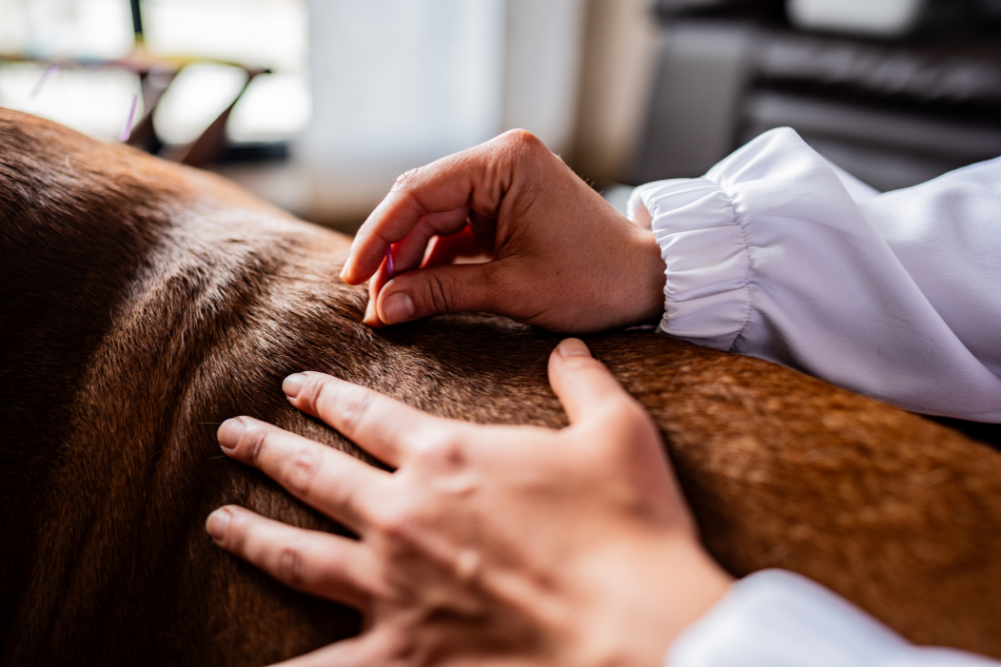
Acupuncture treatment goals include expelling Wind (LI4, ST4, ST6, GB20 and LV3), resolving stagnation (LI10, ST4, ST6) and tonifying Qi and Blood (ST36).
How I treated myself
I started by trying to needle my own points, but with blurry vision, and especially since some of the points are around my lips and eyes, I sought the expert help of a local TCM practitioner. I had two treatments two days apart, and my symptoms immediately improved.
I also added some herbs and supplements. PEA (palmitoylethanolamide) significantly reduced the neuropathic pain. Milk Thistle supported my liver after the course of prednisolone. Withania somnifera (Ashwagandha) is an adaptogen; research indicates it can promote nerve regeneration, speed up functional recovery after peripheral nerve injury and improve motor and sensory functions.
I had an appointment with a physiotherapist, too, and used a combination of massage and nerve and muscle memory exercises to retrain my muscles and nerves. In addition, I prescribed brain rest, which included binge-watching the whole fourth series of Bridgerton.
Six weeks later, I am free of pain and my symptoms are barely noticeable. I know this is a limited case study but I am confident that the combination of initial conventional workup and the holistic therapies, especially the acupuncture, is responsible for my rapid recovery.
The acupuncture points
Many of the points used to treat facial nerve paralysis make sense from a neuroanatomical perspective as well as a TCM one.
Local points (around the face)
- ST4 Located next to the lips, near the buccal branch of cranial nerve VII (the facial nerve). ST4 expels Wind and benefits facial muscles. From a conventional perspective, it improves local blood flow, supports nerve regeneration and neuromuscular function.
- ST6 Located in the central masseter (cheek) muscle region, and adjacent to the facial nerve branches. Dispels facial Wind and removes channel obstruction.
- GB20 Located in the occipital region, at the back of the skull. Needling this point dispels internal and external Wind. This area influences the brainstem via trigeminal input and modulates abnormal neurological activity (such as seizures).
This article is featured in WellBeing Magazine 224