The Joy Reset
It was a familiar refrain in my household — a small, chaos: “Mummy, mummy you’re not listening. Put your phone away.” But that Tuesday, it landed with more weight than usual. I didn’t like the way my son saw me: distracted, half-present, worn down. Between managing two businesses, solo parenting, older parents and squeezing in crumbs of exercise, I was stretched impossibly thin. And somewhere in that moment — burnt toast, inbox overflowing, child tugging at me, I realised I didn’t need a break. I needed to stop, before I broke. Never one to do things in halves, I booked a trip to Bhutan.
Bhutan isn’t an obvious choice for a midlife reset. It’s not “lounging in linen” or “sipping something green” at a silent retreat. But ever since I was a teenager, I’d been fascinated by this Himalayan kingdom that I’d heard existed in quiet defiance of everything the modern world holds dear. A country that measures success not by profit margins but by happiness.
Three weeks later, I was on a flight weaving precariously through the Himalayas toward Paro, Bhutan’s capital, and home to one of the world’s most dangerous runways. When we landed, instead of the usual baggage claim dash, every single passenger simply stood there — silent and wide-mouthed on the tarmac, encircled by the majestic mountain peaks. I’ve visited more than 40 countries but never experienced anything like this. And it was precisely in that moment that I knew that I was exactly where I needed to be.
Bhutan
Nestled between the economic and political powerhouses of China and India, with a population of just more than 760,000, Bhutan, a country never colonised, truly beats to its own drum. Thick lush forests blanket most of the land and it is the world’s first carbon-neutral country. You won’t find a single billboard, McDonald’s or even traffic lights disrupting their way of life. Foreign visitors were only permitted to arrive in the 1970s, and television and the internet were introduced in 1999.
I was determined to start the trip with an experience both wholesome and humbling: a night in a Buddhist monastery. I had imagined being driven, suitcase in hand, to the front gate. The reality was different. Dropped at the base of a steep mountain with only my backpack, my guide reassured me it’s an easy hike that locals do in an hour. It took me two and a half — a thunderstorm didn’t help, though it was mostly my fitness. We reached at twilight and out of the fading light, the Dodedrak Monastery appeared, glowing against the sky. Its sudden presence was breathtaking. Butter lamps in the 12th-century monastery glistening like stars on stone and the thick scent of incense welcomed me. I slipped into the temple in time for evening payers where dozens of burgundy-adorned monks chanted ancient scriptures in unison. The vibrations settled deep in my bones. Within minutes, my shoulders dropped, my breath slowed and I felt a calm I hadn’t known in years. That night gave me a glimpse of what Bhutan could teach me. But the moment that truly cut through my digital, zombie state came further into the mountains — in the tiny village of Laya.
Laya
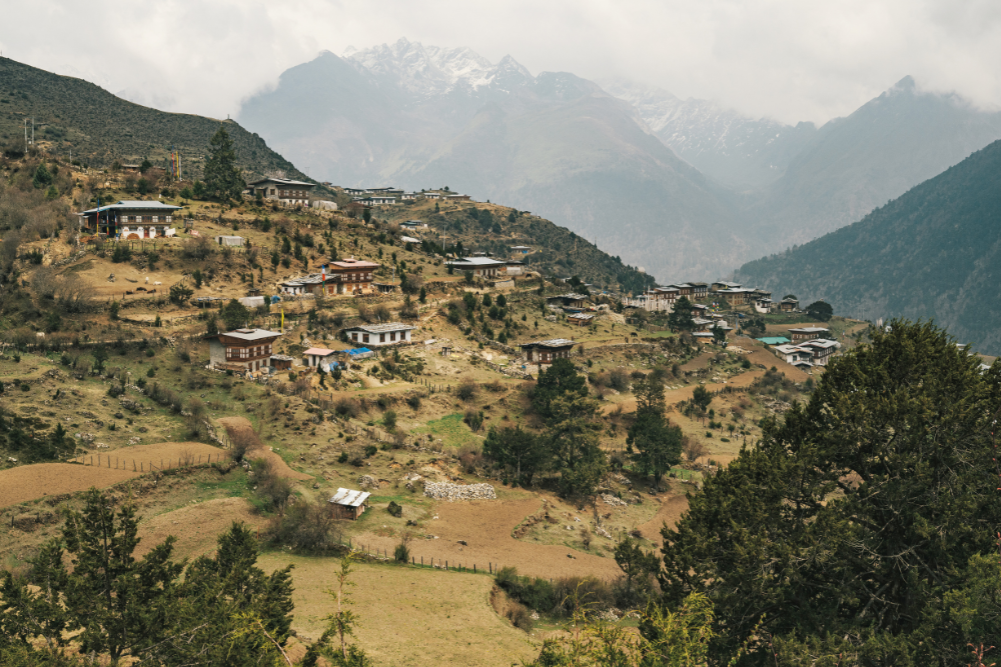
Planning the trip, I had one non-negotiable: visit one of the most remote inhabited villages on Earth. Laya, perched high in the mountains at 3800m, is only reachable by hiking. No roads. Just yaks, ponies, mountains and an inconceivable magic no travel brochure can prepare you for.
Around 1600 Layap people, an indigenous community with Tibetan roots, live in stone houses tucked beneath the towering, snow-capped peaks, including the sacred Tiger’s Peak.
Local guide Pema Wangchuk described his adoration: “It feels as though [Laya] is where the earth touches the sky. Equally as special is the hospitality. Every guest is welcomed with tea, and when a family builds a house, the whole village comes to help, knowing that kindness will always be returned.”
I stayed in the home of Am Pem, a recently widowed mother of the village chief. Am Pem’s husband of 60 years passed aware a mere four weeks ago. Her cosy kitchen, warmed by a woodfire stove, doubled as her bedroom. My own room was larger but freezing, lined with towers of brightly coloured blankets. Even wrapped in layers, the mountain cold seeped in, and not even the fatigue of the hike could coax me to sleep.
By morning, the village was alive with the Bumkor Festival, held only once every two years. Am Pem found humour in dressing me in her yak wool coat, long black skirt and striking conical hat before ushering me into the crowd. Sacred texts were carried in a grand procession through the village, accompanied by the Tsendhar — a rolled flag once borne by ancient warriors. Villagers of all ages sang, danced and shared food until the whole community appeared to move as one. I stood still, mesmerised by the riot of colour against the white towering mountains and the rhythm of the villagers gliding in circles. I also felt an ache. The joy of moving together as a community, of being known, is what I miss most at home. I rarely feel that kind of belonging.
That night, sitting cross-legged on the floor, we ate a simple and delicious spread of butter-sautéed mushrooms, boiled eggs, fiery chilli and steaming rice. I asked Amma what advice she had for living a long and happy life. She didn’t hesitate: “To be happy, don’t be greedy. Make the most of what you have. In our village, if we have enough rice to eat, then we are happy.”
It sounded simple, but her words made my throat tighten, because I knew how rarely I felt that kind of contentment. Back home, I could open the fridge to four types of milk and still feel dissatisfied. I scrolled endlessly and wanted endlessly. Sitting there, I felt ashamed of my own hunger — not for food, but for more. Amma’s happiness was measured in a bowl of rice. Mine had no measure at all.
Wellbeing in Bhutan
There’s something profound about being in a place where wellbeing isn’t a lifestyle brand but a daily practice. Healthcare is free. Education is free. Trees are sacred. And compassion and kindness are the glue binding this matriarchal society together. I could feel it in almost every interaction I had, ranging from yak farmers, students to diplomats. The question, “How can I help my community?” is taught from childhood and carried for life. This spirit of collective care was, for me, the most unique part of Bhutan.
Bhutan is also known for its philosophy of Gross National Happiness (GNH), which places human wellbeing above economic growth. No policy or project moves forward without passing the GNH lens: will it protect culture, community and the environment, or will it cause harm? If it risks harm, it does not proceed. In 2022, Bhutan’s GNH index showed that nearly half the population described themselves as happy.
Of course, wellbeing here is not only in policy, but an everyday practice. Most memorable of this trip were the famed Gasa hot springs. I pictured a lush spa with terraces of steaming pools. What greeted me instead were two plain large baths, with locals crammed shoulder to shoulder. I politely told my guide I’d skip this experience. He insisted I try “for 10 minutes, Maam”. I gently entered the warm water, wedging myself between two elderly (naked) women. I struck up a conversation with a young medical student who explained that she and her mother had driven six hours just to soak here. Only then did I understand: these springs are sacred ground. Legend says a 13th-century saint scattered 128 medicines here, giving each pool its own healing power. Forty-five minutes later, I climbed out, relieved it was over. But by morning, my aches had melted away, leaving me light, refreshed and ready to climb again. No luxury spa could have done the same.
In Bhutan, nature itself is medicine. Research shows time in forests and mountains lowers stress and improves mood, and I felt this truth with every hike and long road trip. The shifting landscapes, forests folding over hills, sudden cliff s, gem-blue streams became a meditation, resetting my nervous system.
In Bhutan, death isn’t hushed. It’s spoken of daily, almost like a friend. Bhutanese are encouraged to think of it five times a day, a reminder that our impermanence brings joy, not despair. I already think about death often, so it was oddly comforting to learn that in Bhutan this makes me productive, not just “morbid” as the West would have it.
And, always, life moves at a slower, kinder pace in this kingdom. Even in towns, the maximum speed limit is 20kmph. On my first day, I powered through the cultural centre, only to have my guide laugh, “I’ve never seen anyone finish visiting so quickly.” Hardly a record to brag about. My usual bullet-train tempo didn’t belong here, though by the end of the trip, I’d managed to shift down a gear or two.
Six months on, I can see Bhutan was not a brief escape but a necessary awakening. Since returning, life has been anything but serene. I’ve faced some of the hardest months I can remember. I’ve been overscheduled to the point of delirium, cried in the car after school drop-off and fallen asleep doom-scrolling. Yet I noticed a shift: I felt better equipped to handle these days.
When the noise builds, I return in my mind to fluttering prayer flags in the mountains, to villagers dancing at the Bumkor Festival. I hear the low chants rolling through the monastery at dusk and the quiet contentment of everyone I met. Those moments remind me to slow down and choose what matters. They steady me when I start rushing, overcommitting and putting myself last.
The truth is, I still stumble into old habits, which, as the saying goes, die hard. But Bhutan left me with something steadier: a way back to enough and being present in that enough.