Tired, But Wired
Katie Robke was studying full-time and raising three children when the exhaustion stopped lifting after sleep. Naturopath Katherine De Jonge had a name for it, and an explanation that had nothing to do with another sleep routines.
It is late. The children are in bed, and the house is quiet. I should finally be ready to rest. I’m in my third year of full-time university study while raising three kids. Being tired feels normal. Expected. But what I am experiencing lately is a different kind of exhaustion, one that does not disappear after a good night’s sleep.
I notice it when I’m staring at my phone, my thumb scrolling while my mind drifts elsewhere. I catch it at traffic lights too, staring into space. It feels like being on standby. Alert, but disconnected.
Outdoors, though, something shifts. Standing barefoot on the grass at the washing line, the sun warming my skin, my shoulders relax and my breath deepens. The sensation is subtle but unmistakable. My body is letting go of something I hadn’t realised I was carrying.
These moments made me wonder whether what I was experiencing was simply parenting burnout, study burnout, or something biologically deeper. When I described the feeling to naturopath Katherine De Jonge, she did not suggest another sleep routine or supplement trend. Instead, she framed it as something more fundamental: a nervous system that has not received the signal that it is safe to rest.
De Jonge sees this pattern daily in clinic.
“When someone feels mentally exhausted but can’t relax or be present, it often points to a nervous system stuck in overdrive,” she says. “We call it ‘tired but wired’. The adrenal system is running flat out, even though the body is depleted. It’s like driving your car with the accelerator to the floor and expecting the fuel to last.”
What the nervous system really does
The nervous system is often talked about in relation to emotion or cognition. But it is also the body’s internal control centre for nearly every automatic function, from breathing and digestion to heart rate, sleep and energy levels. At any moment, it is assessing whether the environment is safe enough to rest or dangerous enough to stay alert.
From an evolutionary perspective, this was protective. The presence of a threat triggered a state of heightened awareness that helped our ancestors respond quickly. Once the threat passed, the body would return to rest.
Modern life, however, does not involve predators on the horizon, not mine anyway. Instead, it is deadlines, phones that buzz at all hours, financial responsibilities and an ongoing stream of information demanding attention. The nervous system cannot always distinguish between significant threat and persistent demand.
Data from the Australian Bureau of Statistics shows that around 44 per cent of adults experience significant stressors, and younger adults are among those most affected. Research also links stress with disrupted sleep, reduced productivity and diminished wellbeing.
When stress becomes chronic, the nervous system cannot complete the shift into its rest state. The result is a body that feels both exhausted and wired. De Jonge explains that the issue is not stress itself, but the absence of recovery.
“It’s healthy for the nervous system to swing between activation and rest,” she says. “Short-term stress gives you energy. Your heart rate lifts, you become focused and motivated to meet a deadline or respond to a challenge. The problem is when the system stays there.”
Over time, she says, the body begins to deplete its own resources.
“Chronic stress burns through nutrients and energy reserves. Everything in the body starts running in survival mode. That’s when people begin to feel flat, foggy and wired all at once,” she says. “The body is tired, but it doesn’t know how to downshift.”
Why modern life keeps us alert
Most of us live in an environment that constantly asks for attention. Even moments intended for rest are often punctuated by screens or reminders of the next task ahead. These cues are not emergencies, but the body’s alarm system treats them as reasons to stay alert.
Many people turn to screen time hoping it will help them ‘switch off’, only to find it reinforces a halfway state, neither fully present nor genuinely calm.
“People often tell me they relax by watching TV,” De Jonge says. “But your brain is still having to follow along. There’s action, storylines, noise. It never really switches off.”
She says the same is true of doom scrolling.
“It feels like rest, but the nervous system is still in fight-or-flight. Over time, that becomes your new normal. Your set point shifts, so everything feels more heightened. You think you’re relaxing, but your body never actually receives the message that it’s safe to.”
When the nervous system speaks through the body
A nervous system that rarely rests will eventually communicate through physical symptoms. These may include fragmented sleep even when you feel exhausted, digestive issues, irritability or low frustration tolerance, feeling overwhelmed by small tasks, and frequent fatigue that rest does not resolve.
These are not isolated problems. They are signals that the body has been in alert mode too long. Its original purpose was to shift fluidly between alert and ease. When the ease phase is consistently cut short, the body attempts to speak through symptoms. De Jonge says many people are surprised by where that strain shows up.
“Digestive complaints are probably the most common thing people don’t connect back to stress,” she says. “IBS, constipation, indigestion. When you’re in survival mode, your body isn’t creating digestive enzymes. It’s shifting energy to your muscles, as if you’re about to run. Over time, that really affects gut health.”
Skin issues can follow. “Hives, eczema, even acne often have a digestive link. If you’re not absorbing nutrients properly or your blood sugar is constantly dysregulated, it shows up on the skin.”
Muscle tension is another frequent sign. “People carry so much load in their neck and shoulders. They’re using auxiliary muscles to breathe. It actually takes more energy to hold yourself well than it does to collapse. When you’re worn out, you slouch, your breath becomes shallow, and there’s no space to breathe deeply. That becomes a chronic cycle.” The body adapts, but at a cost.
Nature as a regulator
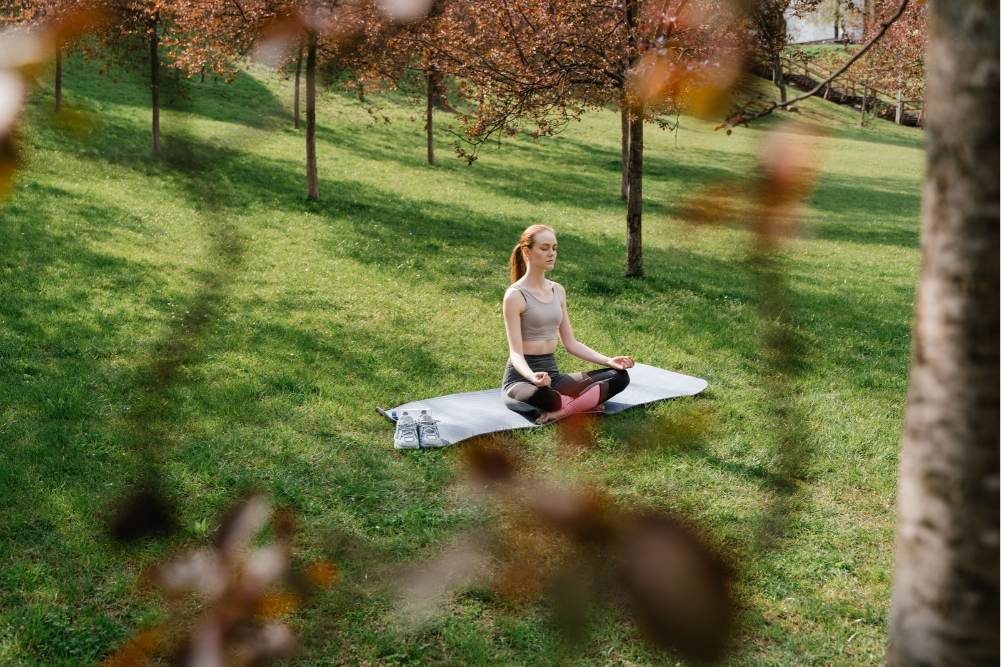
One of the most accessible ways to support nervous system regulation is through time spent in natural environments. This is not about escapism or pricey wellness retreats. It is exposure to sensory environments that signal non-threatening safety to the nervous system.
Spending time in nature has been shown to reduce stress hormone levels. In one study, just 20 minutes in a natural environment was linked with lower cortisol, the body’s primary stress hormone. Controlled walk studies have found that time in green spaces reduces physiological stress responses more effectively than equivalent time spent in urban settings.
Time outdoors is connected with improved mood, better sleep quality through circadian rhythm regulation, and enhanced focus. These benefits are not limited to wilderness. Even brief exposure to local green spaces, birdsong or parks can reduce feelings of loneliness, depression and stress for hours after.
De Jonge sees nature as a direct counterbalance to modern stress.
“On an energetic level, being in nature resets the body,” she says. “But there’s also the very practical side. You’re getting vitamin D, fresh air and space.”
She explains that natural environments are the opposite of what pushes us into fight-or-flight. “There’s nothing demanding your attention. Nothing urgent. Your brain can finally switch off because there’s no threat to track. That sensory experience tells the nervous system it’s safe.”
Small practices that help
Helping the nervous system learn calm does not require intensive routines or expensive gadgets. Simple practices include spending at least 20 minutes in nature most days, walking barefoot on grass or ground when possible, taking slow, focused breaths with a longer exhale, noticing sensory details without multitasking, and preparing and eating meals without screens or distractions.
The point is not intensity but consistency. These are not quick fixes but ways to send the body regular signals of safety. De Jonge encourages people to think in moments rather than routines.
“Breathwork doesn’t have to be big,” she says. “It can be as simple as standing in the shower and slowing your breath. Five minutes of being present can be enough to start shifting things.”
She suggests pairing regulation with daily tasks. “Cooking is a beautiful opportunity. Being present with the smells, the colours, the process. That sensory engagement stimulates digestive enzymes too, which helps curb IBS symptoms, breaks down food more effectively and resets the nervous system. You’re nourishing yourself on more than one level.”