Is your diet chewing up the forest?
Of the world’s environmental challenges, one of the most urgent is deforestation. It does not receive as much attention as it deserves and rarely makes the news headlines. Since peaking in the 1980s, its incidence has fallen, but it still affects about 10 million hectares of land per year. It also represents somewhere between 12 and 20 per cent of global greenhouse gas emissions.
Agricultural expansion has been found to be responsible for nearly 90 per cent of global deforestation according to UN figures. The average consumer is likely to be contributing to this issue, but by modifying purchasing decisions, this environmental impact can be reduced.
Among the consequences of this forest loss: large numbers of animals and birds die or are injured; biodiversity is eroded and species sometimes go extinct; human rights violations can occur, including those of indigenous people; the frequency of wildfires increases; flood risk is increased when there are not the trees and vegetation to soak up water from extreme rain events; rainfall levels are disrupted; and macro-scale effects occur, such as the expansion of existing savannah areas in the Amazon basin.
Palm Oil
This oil is particularly notorious for its deforestation associations, especially in Indonesia and Malaysia, the world’s two largest producer countries. Creatures threatened in that region include orangutans, tigers, elephants, rhinos and gibbons. Parts of the world currently seeing increased palm oil cultivation are Central and West Africa, and Central and South America.
Palm oil is frequently used in processed foods because it has traditionally been the cheapest option. From a consumer angle, palm oil is found in up to 40 per cent of supermarket products and is often labelled as ‘vegetable oil’. Both of these factors make it difficult to avoid entirely.
New Zealand leads the world in importing palm kernel expeller (PKE) as a cheap feed supplement for dairy cows. Because this is a byproduct of oil production, it does not directly generate any additional forest clearing, although its use may generate extra income for the palm oil industry.
Over the years, there have been debates over whether to boycott palm oil or to look for an environmental certification. What is known as Certified Sustainable Palm Oil (CSPO) covers a wide range of environmental and social goals, including deforestation. The supply chain options are identity preserved/segregated (100 per cent CSPO), mass balance (CSPO mixed with uncertified oil) and credits (encouraging the production of CSPO elsewhere in the system). Sometimes these are indicated on product labelling, with mass balance labelled as ‘Mixed’.
Certification of CSPO is administered by the Roundtable on Sustainable Palm Oil (RSPO), which has been criticised by Greenpeace UK for not introducing a deforestation ban for CSPO until 2018, 14 years after the RSPO was launched. In 2025, a controversy arose when NGO allegations that a RSPO-certified Indonesian conglomerate controlled a network of deforesting shadow companies were dismissed by the certifier.
A fairly recent and more rigorous eco-certification is Palm Done Right (PDR), which incorporates organic certification and Fairtrade, encouraging polyculture and the cultivation of palms alongside native vegetation. Most come from small farmers in Ecuador and West Africa.
Coconut Oil
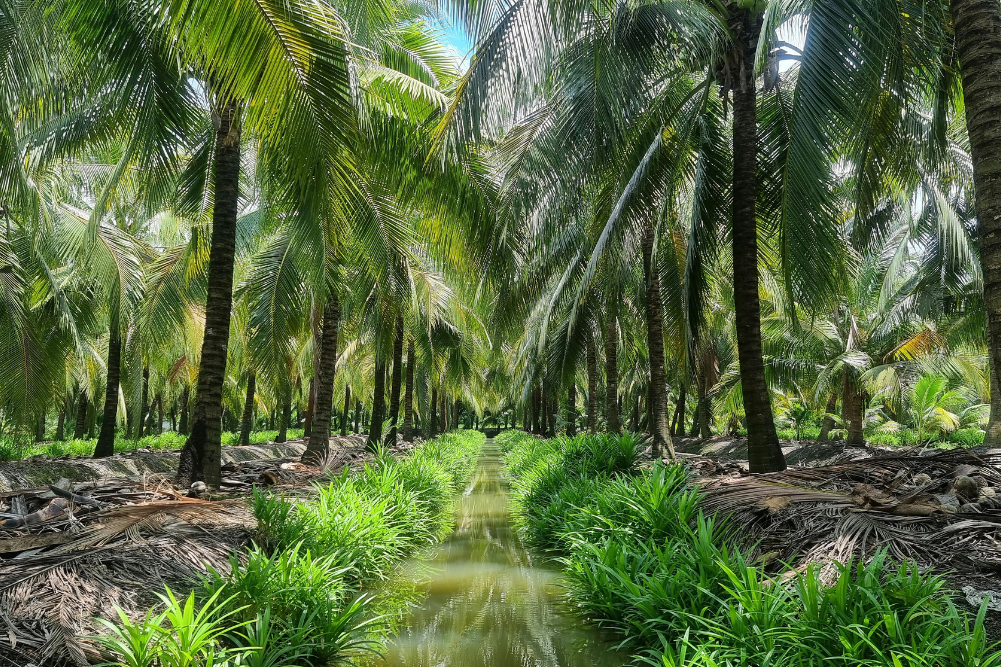
This tropical oil crop is generally grown in monoculture plantations. However, unlike palm oil, which is in some regions heavily dominated by huge corporations, an estimated 95 per cent of coconut oil producers are smallholders. The top producer countries are Indonesia, the Philippines and India. Unlike palm oil, coconut in its various forms is a product that people can widely purchase in the supermarket and is popular in healthy eating circles.
Some deforestation has occurred as a consequence of coconut oil production. Historically, some of the greatest localised impacts to nature have been in Pacific atoll countries.
From a biodiversity perspective, there is a general consensus that environmentally, coconut oil is a better option than palm, if there were a choice between the two. According to the International Union for the Conservation of Nature (IUCN), oil palm has threatened 321 species, while coconut farming has threatened 66. A multi-stakeholder initiative called the Sustainable Coconut Partnership was launched in 2023, and it aims to tackle deforestation, among other issues.
Soya
Grown in tropical, subtropical and temperate climates, most soya is grown for two end products: soya meal, used in livestock, poultry and fish feed (this is the destination of nearly 80 per cent of soya grown worldwide, with the EU the world’s top importer); and soya oil, used for human consumption and industrial processes.
Soya meal is attractive as an animal feed because it is relatively cheap and high in protein. As a consumer, when it comes to finding out whether it is used as feed in the production of an animal product, there is obviously no labelling to refer to.
In South America, parts of Brazil, Paraguay, Argentina and Bolivia are seeing large swathes of soya-driven forest destruction. The crop is often grown on land previously cleared for cattle, while cattle farming tends to create more deforestation in other areas. The IUCN survey mentioned earlier identified 73 species threatened by soya cultivation. Australia’s small soya industry does not have the deforestation associations attached to imported soya. In addition, human consumption of soya via products such as tofu and soya milk poses no significant threat to forests.
The Rainforest Alliance and Other Certifiers
Two ways to use consumer power to leverage a more ethical outcome are to boycott a particular ingredient, or via independent sustainability certifiers.
One of these is the Rainforest Alliance (RA), an NGO known for its frog certification logo. It extends to a range of deforestation-prone foods including coffee, cocoa, coconut oil and palm oil. Its Sustainable Agriculture Standard includes a deforestation cut-off date of 2014. The two options are segregated fully certified ingredients, and mass balance which requires at least 90 per cent certified content for all foods except for palm oil, where the threshold is 30 per cent.
Organic certification frequently entails stricter deforestation rules than mainstream agriculture, but this is not guaranteed. The IFOAM-Organics International benchmark standard only excludes the clearing of high-conservation-value forest within the five years prior to receiving certification.
Coffee
The coffee industry is a driver of some tropical deforestation, including in Brazil, Vietnam and Indonesia. Over the past 30 years, coffee consumption has shot up by 60 per cent, pushing the industry to grow in size and often abandon sustainable growing techniques.
Traditionally, coffee was grown in shade under the natural forest canopy, in a type of agroforestry that supported biodiversity. However, since the 1970s there has been a shift towards sun-grown coffee, which has a higher yield and is less labour-intensive.
Cocoa
These egg-shaped pods are grown in tropical regions, with production dominated by West Africa, especially Côte d’Ivoire and Ghana. This region has seen heavy deforestation; Côte d’Ivoire has lost at least 90 per cent of its natural forests, and in Ghana the figure is about 65 per cent. Some responsibility for this can be laid at the door of the cocoa industry.
Cocoa is heavily dominated by smallholders whose farms are two to five hectares in size. The best option for forests is for it to be produced in agroforestry systems alongside other trees and bushes.
Beef
In 2021, conservation scientist Dr Martin Taylor carried out a satellite analysis that matched large-scale landclearing in Queensland to cattle properties; about 73 per cent was found to be linked to the beef industry. This is despite a state law passed in 2018 with the intention of curbing land clearing, including of “high-value regrowth”.
Cattle farming has been named by Greenpeace as the primary cause of Australian deforestation. In 2025, Coles announced that it would source only deforestation-free beef by the end of the year. In its latest annual sustainability report, Aldi says it is in the process of making the same transition.
On the other side of the globe, the world’s worst beef-related deforestation problem is in South America, especially Brazil, which is now the world’s top producer and exporter. It has been calculated that beef represents about 80 per cent of Amazon basin deforestation.
Population and Affluence
Inevitably, population growth will remain a driver of food-related deforestation. Furthermore, as regions of the planet such as Southeast Asia transition to a more affluent middle-class existence, people generally eat more meat. According to the UN Food and Agriculture Organization, global per-capita meat consumption increased by about 25 per cent within the relatively short interval between 1990 and 2009. With population growth also factored in, total meat consumption rose steeply by about 60 per cent in the same timeframe.
An important consideration is that a chunk of food-related forest loss is to produce food that is later wasted — but on the bright side, cutting food waste is an easy way to ameliorate the problem.
Deforestation is a conundrum with no simple answer, but one that is important to address, and is worth viewing from a range of different perspectives.
This article is featured in WellBeing Magazine 223