The melanoma man
When Jay Allen was at the gym, he paused as he noticed a distinctive scent. Turning to the man training next to him, Allen asked, “What is that smell you’ve got on, if you don’t mind me asking?” He didn’t realise that this question, this moment, would change the trajectory of his life forever.
The man told him the scent was an accelerant, a skin lotion, to help him burn faster in the gym’s solarium, or sun-tanning bed. “You should try it, chicks dig it,” the man said. Being in his early 30s and single at the time, looking good was high on Allen’s priority list. After using the solarium a couple of times, coming out bronzed, Allen was hooked. “We’d go to the gym, do a workout, and then on the way out, use a solarium and get all tanned. You knew you looked good and felt good mentally, but little did I know that I was potentially killing myself.”
At the age of 32, Allen was diagnosed with stage 3 melanoma, the most dangerous and aggressive form of skin cancer. Melanoma’s primary trigger is exposure to ultraviolet (UV) radiation, such as from sun exposure or tanning beds. By this point, he’d used the solarium around 40 to 50 times, sometimes double or triple sessions. Allen’s doctor told him that solarium usage was probably a huge contributing factor in his diagnosis.
Sun exposure affects everyone; two in three Australians will be diagnosed with some form of skin cancer by the age of 70. But Allen’s case shows that young people are at high risk too. Using a solarium before the age of 30 increases the lifetime risk of developing melanoma by approximately 59 to 75 per cent, according to research reviewed by the International Agency for Research on Cancer (IARC). But when Allen, now 51, started usinsolariums, he says there was no education about the risks, no warning posters or waivers to sign.
After surgery and months of treatment, Allen recovered. But his difficult journey gave him a renewed sense of purpose: to ensure that no one else goes through what he did, feeling alone, unsupported and unheard.
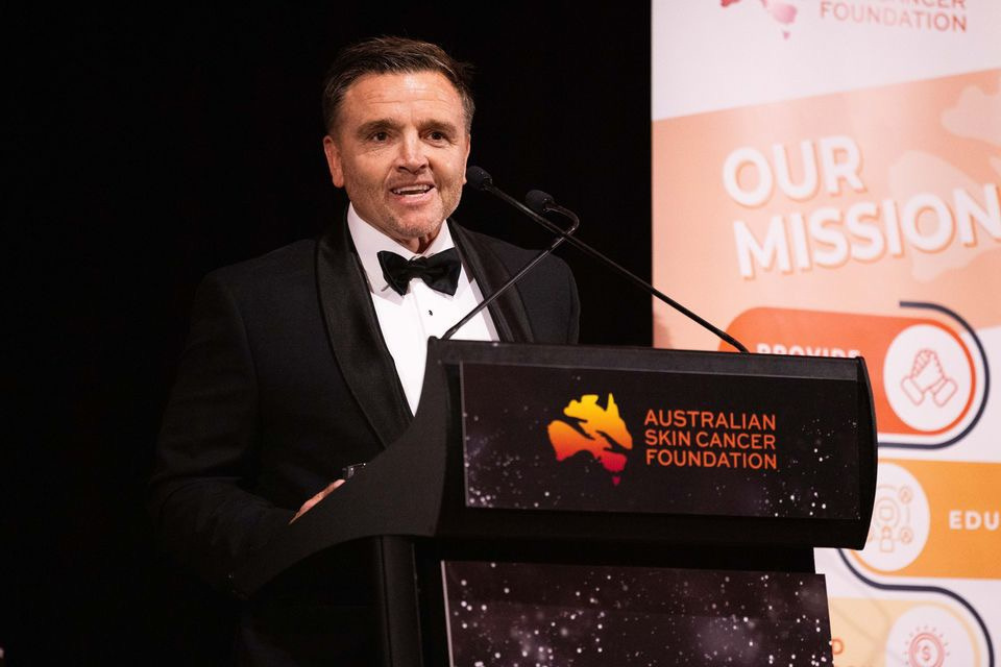
In 2014, after months of Allen’s campaigning and advocacy, commercial solariums were banned in NSW, and all other states followed by early 2016. Later, in 2021, Allen founded the Australian Skin Cancer Foundation (ASCF) and serves as CEO. ASCF has raised over half a million dollars for skin cancer research and in 2023 launched an initiative that delivers free mobile skin checks around Australia, which has already saved potentially hundreds of lives.
Allen was also awarded a Medal of the Order of Australia (OAM) in the 2021 Australia Day Honours List for his advocacy and service to people living with melanoma.
Peeling sunburn
Allen grew up in Sydney’s western suburbs. Hisdays were spent outdoors playing rugby with his friends. In school holidays they would visit cousins in Wollongong, south of Sydney. “We’d go down there on the weekend and ride our bikes around the Bulli track and go to the beach,” says Allen. While his mum would encourage them to wear SPF cream, sun damage wasn’t something that was front of mind. “We used to get sunburned all the time, and there was no ‘slip slop slap’ back then that we knew of.” Peeling sunburn off each other’s backs was often a game to see who could get the longest strip of skin.
Allen loved sports and had dreams of becoming an NRL player. He came closer than most, earning an invitation to train with the Cronulla Sharks in the off season, but ultimately fell short of this dream. He later found joy in his job as a truck driver.
While he was aware of melanoma when he started using solariums at the gym, he never thought it would happen to him, especially not in his 30s. Allen thought: “Skin cancer was an old person’s disease.” But he couldn’t have been more wrong. Melanoma is the leading cancer in Australians aged 20 to 39. “You don’t think about that stuff; because you’re young, you think you’re invincible and you’re just not worried about any risks.”
Mole or melanoma?
In late 2007, Allen took his socks off after a long day. He noticed a red swollen mark on his ankle. A blister, he assumed, from his work boots. But months later, the mark was still there; sometimes it would bleed. Allen also started to feel unusual in himself. “It was like I had an itch inside my body. I just didn’t feel right and I knew something was up,” he recalls. Around six months after first noticing the mark, Allen’s fiancée, Janine, convinced him to get it checked by the GP. “He took one look at it and said, ‘It’s got to come out straight away.’”
After removing the mole, the doctor called Allen with bad news: “Jay, it’s a melanoma, it’s serious, you need to go and see the specialist now.” Allen had no idea just how serious. The cancer had spread to his lymph nodes, giving him a 50 to 60 per cent chance of survival. What followed was months of painful surgery and treatments.
During his time at the hospital for treatment, Nine Network approached Allen to document his hospital journey for the TV show RPA, a reality program following the workings of Sydney’s Royal Prince Alfred Hospital. When his doctor suggested that sharing his story may help to raise awareness and encourage others to get skin checks, Allen agreed to be filmed.
After it aired, Allen started to realise the power of sharing his story with the world. Even years later, he still hears from people whose life changed after seeing his story on TV. One woman noticed something unusual when shaving her legs and said that Allen’s RPA episode motivated her to get it checked. “She kept getting this spot that was bleeding on her legs for quite a few months, and it wouldn’t heal,” says Allen. “She got it checked and biopsied, and it came back as melanoma. So it saved her life.”
With Australia having one of the highest melanoma rates in the world, Allen encourages Australians to see their GP or healthcare professional if they notice any concerning changes to their skin. Warning signs can include a mole, freckle or spot that is changing in size, shape or colour, has irregular borders, contains multiple colours, becomes itchy, painful or tender, bleeds, or simply looks different from other spots on the body.
Sun bed ban
Looking back, Allen sees his decision to use solariums as his biggest regret. What had started as an activity to look good had left him with 44 staples from his stomach to his thigh after a painful surgery to remove every lymph node in his groin. “I was 32 and I had a big incision in my groin, and staples. I just felt I had to do something about it. I had this drive to get out there and warn other people, because I just didn’t want them to go through what I was going through.”
This drive pushed Allen to create a website,sunbedban.com, and to send out emails to politicians and media to garner support. But it wasn’t smooth sailing. He received a death threat from a man who had just spent over $75,000 setting up a solarium business for his wife. Alan Jones, then host of Sydney’s 2GB radio show, replied to Allen’s email with, “The chances of you banning solariums are like closing down Bondi Beach. It’s never going to happen.”
This pushback only made Allen more determined. He soon realised that he needed an understanding of the political lobbying process, so when the opportunity to do work experience with The Greens presented itself, Allen grabbed it with both hands. Over several months, he learned how to use his voice for influence, how to get meetings with the right people, and how to advocate for change.
Alongside a friend and fellow melanoma survivor, Allen visited treatment centres, knocked on doors, and gave talks to universities and hospitals. He volunteered with Melanoma Patients Australia and started support groups to help others feel connected and less alone in their cancer experience.
In 2012, Allen was driving when he received a call from the Environment Department, the decision makers behind a potential ban of the solariums. Legislation was approved to ban solariums in New South Wales, in eff ect from the end of 2014. “I just pulled over and started crying. It was pretty surreal,” says Allen. The department congratulated Allen and said he played a big part in the success of the ban.
It was around this time people would start referringto Allen as ‘The Melanoma Man’. It’s a name he pushed against to begin with, not wanting to be defined by melanoma, but now embraces as a part of his mission to raise awareness.
Mission melanoma
In 2021, after melanoma recovery, Allen received another blow: a second cancer diagnosis. This time it was squamous cell carcinoma, throat cancer, which involved regular radiation treatments for seven weeks. In this time, Allen dropped 14 kilos as the pain made it impossible to eat properly. He got through the ‘brutal’ sessions by listening to the Rocky soundtrack. While scars remain, Allen was cured, making him a two-time cancer survivor.
During his treatment, Allen thought the internet might bring connection with others, but it often delivered stories of failed treatments, grief, and people losing their life to the disease, only heightening his sense of despair and isolation. Allen feels that having someone, a survivor, share their story, to show him there was a way through it, would have made a huge difference.
Determined to help more people, Allen launched the Australian Skin Cancer Foundation (ASCF) later that year. Part of its aim is to educate people on skin cancer, fund research, and deliver life-saving free skin checks across the country. Its key fundraising event is the Mission Melanoma Walks, multi-day walks to not only fundraise, but to bring together those who have survived or been impacted by cancer. After its first fundraising walk in 2022, a 333km trail from Canberra to Sydney, ASCF was able to contribute $100,000 into the BETTER clinical trial, which explores new treatment options for melanoma brain metastases.
Skin check trucks
In 2023, ASCF launched its first skin check truck, which delivers free skin checks and skin cancer prevention education to communities across the country. On the side of the trucks are photographs of almost 100 people who have lost their lives to skin cancer.
In December 2025 they launched a second truck, a mobile clinic including a biopsy room, and Australia’s first 3D mobile skin check clinic. So far, the trucks have completed more than 14,000 skin checks across 163 communities. They’ve detected 5000 non-melanoma skin cancers and identified over 178 suspected melanomas, providing opportunities for early intervention and treatment for those affected.
While he’s the CEO, Allen doesn’t just sit behind a desk, he’s on the road with the trucks, meeting with people and communities. “I’ve had a few comments from people saying, ‘You’re the CEO, what are you doing out here?’” says Allen, smiling. “I get a lot out of helping people. We’re on this mission now to roll out more trucks across the country and pretty much build it up like the breast screen model, so there are trucks available for people in rural areas to get a skin check and save their life.”
According to the National Institute of Health, farmers and outdoor workers receive between fi ve and 10 times more UV radiation exposure than indoor workers. That’s why the trucks don’t just stick to metropolitan areas. Rural Australians also face more barriers to getting skin checks due to not having clinics nearby, long wait times, or lack of specialised local healthcare professionals, with fewer than 10 per cent of practising dermatologists serving rural communities.
One man in rural NSW who attended the skin check trucks recently had never had a skin check despite working outside as a farmer for 30 years. “We got him in, he took his shirt off, and he had this big melanoma on his back,” says Allen. “The nurse came out, said, ‘Jay, this is a very aggressive type of melanoma, I’m pretty confi dent it is, you need to get him into the doctors to get a biopsy straight away.’” Allen and the team immediately organised to get the man to the local hospital.
Without the skin check truck, it probably would have gone unnoticed and untreated. “This mole on his back was like a burnt steak,” recalls Allen. “He hasn’t got a wife or a partner, so no one’s seen his back for a long time. Stories like that stick out and let us know that we’re doing the right thing.”
Being a small charity, without government funding, the trucks try to visit as many communities as possible. The schedule can be viewed and visits requested on the ASCF website (australianskincancerfoundation.org).
Stay sun-safe
While Allen is busy with his advocacy and ASCF, he spends any relaxation time with his family. He lives in NSW’s Southern Highlands with Janine and their five kids, and he also has two adult children from previous relationships. Alongside family, his priority is health, both physical and mental. He starts every day with fitness training, either a 3km run, circuit training or a treadmill jog.
Allen hopes that sharing his story will help others avoid the journey he’s been on. “Cover up. Live a sun-safe lifestyle, apply sun block, and certainly don’t chase that tan,” says Allen. While solariums may be banned, sun exposure can have the same impact if you don’t take the right precautions. If you’re heading outside or to the beach, wear a hat, sunglasses and sun-protective clothing. Cancer Council NSW advises applying a water-resistant broad-spectrum sunscreen of at least SPF 50 twenty minutes before sun exposure, and reapplying every two hours, or more if towel drying, swimming or sweating excessively. The decision you make today could save your life later.
“I’ve heard it so many times; when people get diagnosed with melanoma, they just think, ‘I wish I could just turn back time,’” says Allen. “People get angry at themselves; don’t be one of them.”
This article is featured in WellBeing Magazin 225