Walking the Bay of Fires
Tasmania is a hiker’s heaven. Susan Elliott joins a guided trek along the Bay of Fires — one of Australia’s most breathtaking coastal trails.
Few things stop hikers faster than fresh poop on a walking track. In this case, the poop cubes are perched in a cairn-like arrangement atop the trail’s tiniest boulder. It’s Picasso-esque perfection. Without inspecting too closely, this dollop of wombat dung suggests, warmly, that Tassie’s “bulldozer of the bush” is nearby.
I’m hiking Tasmania’s Bay of Fires, Larapuna, with Intrepid Travel. It is a three-day experience curated for those who have an adventurous nature but a soft centre. It’s for people who adore the great outdoors but love the great indoors for air-conditioning.
Our trip begins in Launceston, where a police officer and a paramedic join our group. Thankfully, it’s no cause for alarm, Ryan and Tam are training to hike the 96km Kokoda Track in Papua New Guinea. At least we won’t need to call 000 in too much of a hurry.
Seventy-five-year-old Betsy, a seasoned tramper, has flown in from New Zealand. Evie is our expedition photographer and Lauren and Scott are our Intrepid guides who explain the itinerary will start soft, punch a little harder in the middle, but finish sweetly.
We begin with a two-hour drive to St Helens, the largest town on Tasmania’s north-east coast and our base camp for the tour. Being forewarned to pack for every season was sage advice. The tip pays off on the first hike along Skeleton Bay Track to Dora Point in the Humbug Point Conservation Area. We’re met with, as I love to call it, “liquid sunshine”. Lauren calls it “wet air”. My new favourite, though, is “sneaky rain” as it somehow slithers through everyone’s waterproof clothing, soaking us to the skin. What isn’t dampened are our spirits or the joy of hiking one of Australia’s most pristine regions. If I could bottle the raindrops rolling off my coat, I would. And the air too.
The Bay of Fires
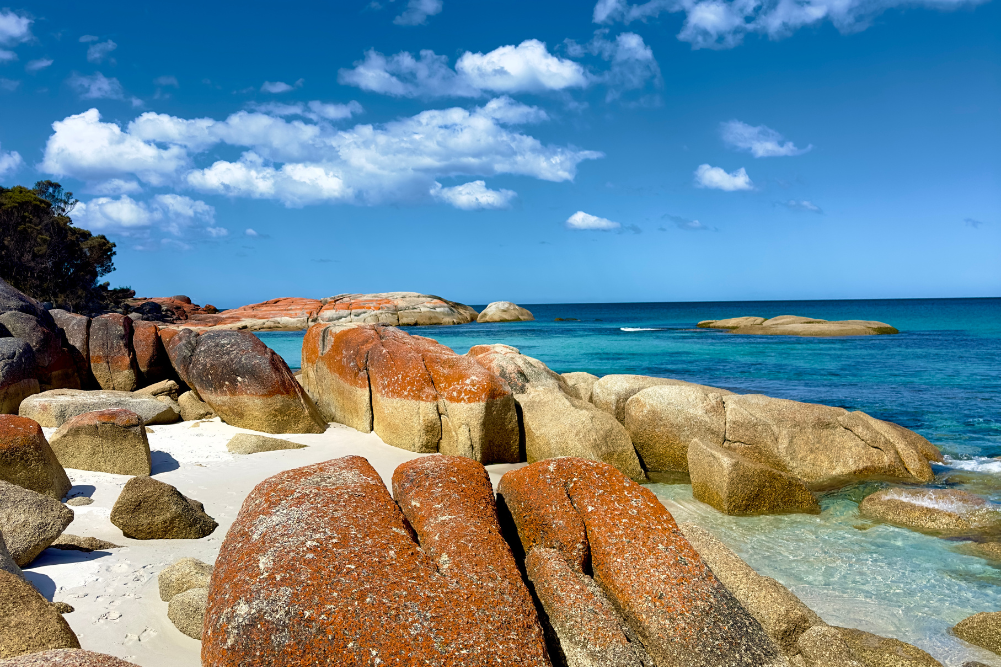
Coastal heath hugs the Tasman Sea then meets a forest of ferns, flowering paperbarks, banksia, tea trees, gums and pines, but it’s the rock “art” (and a few inclines) that make us breathless. The Bay of Fires was named in 1773 by English navigator Captain Tobias Furneaux. From HMS Adventure, he sighted fires along the coast — the burning coals of Tasmania’s Palawa people. Two-and-a-half centuries later, the coastline still glows, although today it’s thanks to gigantic granite boulders crusted with burnt-orange lichen. These rocks are the 21st-century beacons that illuminate the bay and, surrounded by blindingly white sand with ridiculously blue water lapping their base, are a hypnotising sight.
One reason, perhaps, why the Bay of Fires was named Australia’s most beautiful beach for 2025.
Tasmania is a hiker’s heaven. Even more heavenly when you don’t have to carry a pack and blissful with a steaming-hot shower after a day spent exploring, chef-cooked meals and a soft bed after sundown.
Honeyeaters, wattle birds, green rosellas and the splendid fairy wren flit around our faces, too shy for photos, but happy to provide birdsong, the percussion for our seaside symphony. Our wombat escort continues to mark the trail but stays in the wings of this wilderness stage.
Echidna! Finally, a bush character presents itself!
On our drive home, Tassie’s uber-cool monotreme puts on a road show. It waddles, snuffling through the understorey, looking, when it stops, like the blackened stump of a burned grass tree. Tasmanian echidnas are as big as they come, with thicker, longer fur than their mainland buddies. They’re dark and spiky, which, I reckon, should be the name of a drink at St Helen’s Panorama Hotel, a freshly renovated property with views stretching across Georges Bay that is our after-hike burrow.
St Helens is Tasmania’s game fishing capital, but loved, too, for its southern rock lobster and oysters.
At dinner, I order a dozen of them, fresh from the bay’s lease 65, a five-minute drive from the restaurant kitchen. They are plump, creamy, sweet, salty and delicious.
Breakfast is a feast too. Dukkha-sprinkled eggs top avocado on sourdough. A chicken omelette with spinach and feta is equally yummy. The Super Bowl — granola and fresh fruit with shredded coconut and chia seed — looks too photogenic to puncture with a spoon. With a backdrop of black swans ducking for weed and oystercatchers tiptoeing across the sand, it’s a waterfront wake-up that beckons us to linger.
But it’s day two of our hike, the big one, so more coffees are ordered and we’re off .
Tasmanian treasures
An hour’s drive up a dirt road is our first stop, Eddystone Point Lighthouse, a 35m-high pillar of pink granite, towering over the lichen-orange granite boulders below. The wind whips in at 50kph, gusting to 68kph, surely a factor in the nautical carnage wreaked off this precarious point. We layer up and, with the wind at our backs, begin a 6km walk along Eddystone Beach. We will be blown away, but not by the wind.
Oystercatchers, peeping like squeaky toys, are our escorts this morning. Pacifi c gulls like feathered stealth bombers glide silently overhead, while sandpipers scurry along the beach, dodging the shore break to pluck worms from their holes. The dunes look like mogul runs, the sand patterned with minerals leached from the rocks. Strands of the beaded seaweed known as Neptune’s necklace have been woven by waves into works of art on our beach path.
Then come the shell coves, the crunchy equivalent of quicksand. Bay after bay is heaped, metres deep, with the old homes of giant cockles and little clams.
We clamber through them, ankle-deep at times, stopping to collect souvenirs (you are allowed to take shells) and pausing to watch the waves.
Eventually, we cross the dunes to a fire trail and a 5km walk back to our bus. Away from the coast, it’s windless and hot. I spend most of the time sweeping sand from my eyes, ears and nose, stopping only to smell wildflowers, as fragrant as a squirt of Chanel No 5. It’s another Tasmanian treasure I wish I could bottle.
All up, day two is a 12km hike, with most of us logging around 25,000 steps. I’ve never been happier to see the stairs that lead to my hotel room.
Lauren’s a born storyteller. Her best tale is that of William Swallow, a convict in Tasmania’s first and harshest penal settlement, Sarah Island. Swallow became quite the escape artist and eventually made his way back to England, where he became the last man put on trial for piracy there. It’s proof Tasmania has, for a long time, been a very wild place.
Our third walking day in Mount William National Park holds fresh hope for a wombat sighting. With close to one million squat marsupials on Australia’s southern isle — twice the population of humans in Tasmania — you’d think it would be hard to dodge them. We arrive at Stumpy’s Bay where, sadly, the name bears no relationship to wombats. Instead, it was named for the chunky rocks on the beach. There are, however, fresh paw prints in the sand, which has me putting one wishful foot ahead of the other, while remembering the hiker’s mantra to look up, behind and around. Rarely is the best view at your feet.
It’s a 6km loop that ends with hot coffee and homemade, ooh-so-chocolaty truffles from the bakery in St Helens.
Fresh local food is a bonus on the tour. Breakfasts and dinners are either cooked by chefs at the hotel or from local restaurants, and we select our own lunch.
The standout, which many of us order three days in a row, is Lifebuoy Café’s veggie wrap filled with a chickpea and lentil patty, spinach, halloumi, housemade pickled onion, dukkha, sweet chilli and hummus.
Everyone, between mouthfuls, tries to say it’s the best wrap they’ve ever had!
Little Blue Lake
“It’ll be a bit embarrassing if it’s not blue,” says Scott on the road trip back to Launceston.
He’s talking about Little Blue Lake. Fortunately, we get to see it, the site of the Endurance tin mine from the 1870s to 1980s, in full sunshine, which makes it look super blue. Alarmingly blue, in fact. The colour is caused by suspended white clay particles and other minerals that make it look awesome, but means you want the photo more than a swim.
Our final stop is for gelato in Derby. Once home to one of the largest and richest tin mines in the world, the town is now a famous mountain-biking destination. It’s the sweet finish promised to us on day one.
The bus is the only place I manage to catch up with Betsy, who set a fierce pace on the hikes, often hundreds of metres ahead of us. “I’m a solo person,” she tells me. “My nature is to be in my solitude. But I like it now, being 75, not having the responsibility of thinking where I’m going next or what I’m going to eat.
“This hike has been absolutely gorgeous. We’ve had rain, sunshine, wind, sand in our faces, all the coastal elements. It’s so good for the body and the mind.”
Ryan and Tam are happy too. They’ve walked 40km, half the length of the Kokoda Track, in just three days. Me? I’m feeling uplifted. Walking in the wilderness does that.
Finally, I see a wombat! It’s tiny, maybe 20cm long, with the cutest dark-pink nose. It’s burrowed in a shelf at the gift store at Launceston Airport and a bargain at $35. I name it Helen (for St Helens) and make a silent pledge to return. If only I could have bottled those raindrops, that air and the perfume of blossoms to last me until then.
Book Your Tour to the Bay of Fires
Intrepid Travel hosts small-group tours leaving from Launceston on select Saturdays between October and April. There are direct flights to Launceston from Sydney, Melbourne and Adelaide. The Bay of Fires walking tour starts at $1680.