The future of beauty is circular
What if beauty could be as regenerative reshaping the industry by turning waste into resource — from upcycled ingredients such as tomato seed oil to refillable packaging and conscious rituals that honour both skin and planet. At its heart, this movement reflects a shift in consumer mindset — away from excess and towards thoughtful, purposeful choices. Discover how this new wave of innovation is redefining sustainability and why the future of beauty lies in closing the loop.
What is circular beauty?
At its core, circular beauty reimagines the industry’s traditional linear model — buy, use, dispose — and instead asks how every stage of a product’s life can feed back into the cycle. It’s not just about minimising harm or reducing waste — it’s about designing systems where nothing is wasted at all.
This approach shifts the focus from sustainability as a checkbox to sustainability as a living process. Ingredients, packaging and even the way we use products are considered in terms of regeneration, not depletion. Rather than viewing by-products as discarded matter, circular beauty reframes them as raw materials for innovation.
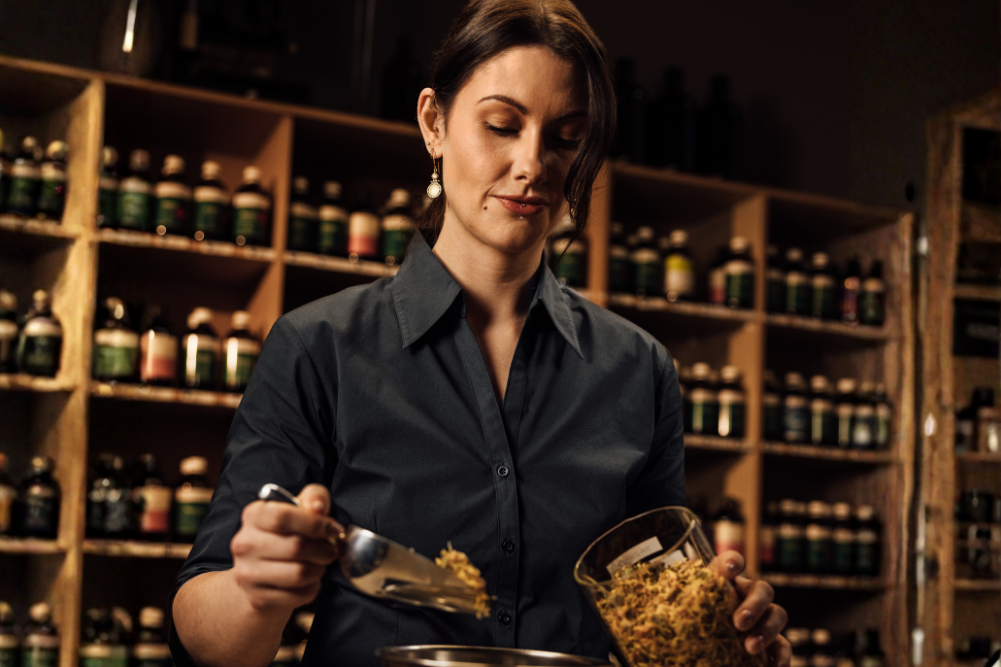
Mukti, founder of Mukti Organics and expert skincare formulator, puts it simply: “Circular beauty goes beyond the idea of simply being ‘sustainable’. It’s about creating closed-loop systems where nothing goes to waste.” What does this mean in practice for skincare? It’s the art of finding new life in overlooked resources — for example, repurposing surplus tomato seeds into high-performance actives. As Mukti explains, “Unlike traditional sustainability efforts, which often focus on reducing waste, circular beauty reimagines it as a resource.”
Essentially, circular beauty represents a fundamental shift: away from a culture of excess and into one of intelligent design, where innovation works with nature’s logic — nothing wasted, everything repurposed.
Ingredient innovations: beauty from waste
Nowhere is the promise of circular beauty more evident than in the ingredients themselves. What was once considered waste is now being transformed into high-performance actives, proving that innovation and sustainability can coexist in the most efficacious, luxurious of ways.
One standout example is tomato seed oil, the hero ingredient in Mukti Organics’ Red Velvet Body Oil. Sourced from surplus seeds — a by-product of the food industry — it embodies the philosophy of turning discarded matter into something of worth.
“These surplus tomato seeds are a by-product of the food industry, so repurposing them not only creates a high-performing skincare ingredient but also helps address Australia’s food waste crisis,” explains Mukti.
Yet beyond its sustainability credentials, tomato seed oil delivers exceptional science-backed skin benefits. Rich in lycopene, a potent carotenoid antioxidant, tomato seed oil has been shown to shield skin from environmental aggressors, support structural proteins and reduce UV-induced damage.
“This supports skin integrity, slows premature ageing and maintains the skin barrier,” says Mukti.
These protective qualities are further supercharged by its essential fatty acids and phytonutrient content. As Mukti explains, “It boosts hydration and elasticity, and softens the appearance of fine lines and wrinkles, while its anti-inflammatory properties also calm irritation and redness for a glowing, clear complexion.”
Seeing formulations centred on such ingredients demonstrates that circularity doesn’t mean compromising on efficacy — it means drawing power from places we once overlooked. And Mukti is not alone. Across the industry, more brands are championing upcycled actives, recognising that what was once discarded can be transformed into skin-loving innovation.
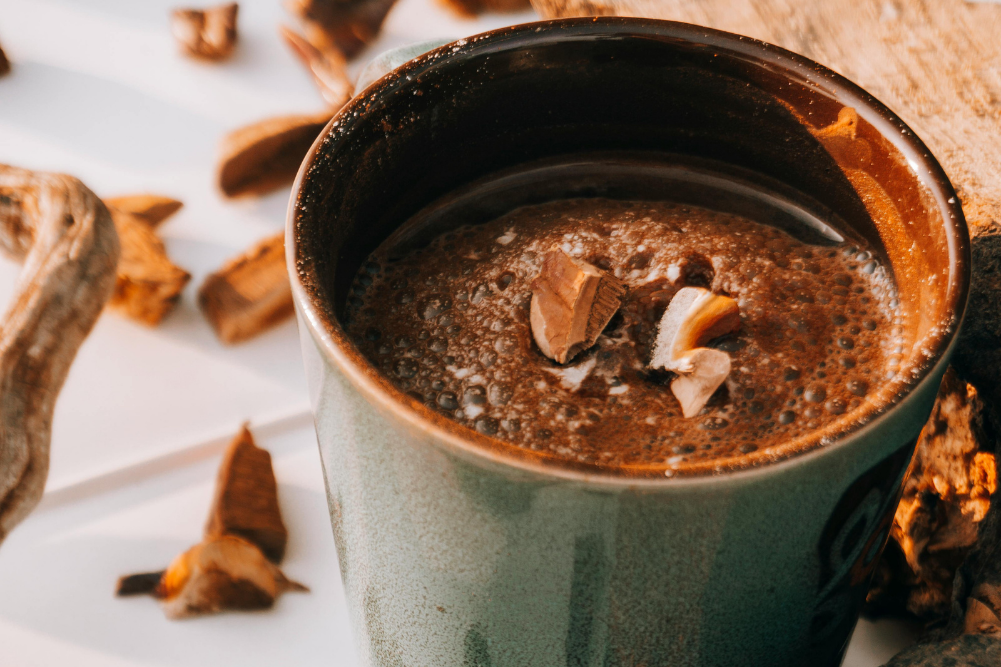
And tomato seed oil is just one example. In the world of beauty products, coffee grounds are being reborn in scrubs, fruit peels are distilled into brightening extracts and nut shells find new life as exfoliants. In each case, once-wasted materials are given a new role while also lightening the industry’s environmental footprint.
“Upcycling diverts waste from landfill, reduces methane emissions and decreases the overall carbon footprint of production,” explains Mukti. “It’s a way of transforming what was once discarded into something both luxurious and sustainable.”
These advances remind us that circular beauty is not simply about recycling what exists, but about reimagining what’s possible — extracting value from the overlooked and creating products that nourish both skin and planet.
Packaging: beyond recycling
Circular beauty is not only reshaping the formulas we apply to our skin but also the vessels they arrive in. For decades, packaging has been one of the beauty industry’s biggest sustainability challenges — shiny plastics, mixed materials and single-use designs that are difficult, if not impossible, to recycle. Circularity shifts the conversation from simply recycling after use to designing packaging with reuse, refills and regeneration in mind.
Across the industry, innovation is taking shape in refill systems, compostable or biodegradable materials and even dissolvable films. Some brands are experimenting with bioplastics made from algae or sugarcane, while others are trialling return-to-brand initiatives that create true closed-loop systems. These approaches move beyond the token recycling symbol, offering practical ways for packaging to stay in circulation rather than ending up in landfill.
Mukti notes that this shift is already underway at Mukti Organics. She is one of many founders responding to the demand for change. From global beauty houses trialling refill pods to indie labels adopting compostable packaging, the movement towards circular design is gaining pace across the industry.
“At Mukti Organics, 98 per cent of our packaging is recyclable, and we’ve eliminated single-use plastics where possible, even down to switching to glass sample pots,” she explains. While these changes can be more costly for a brand, they are long-term wins for the environment.
“We’re also seeing momentum in refillable and waterless formulations, as well as onshore manufacturing to reduce transport emissions,” Mukti adds.
For consumers, small choices can make a significant difference. Supporting brands with refill programs, choosing recyclable or compostable packaging and rethinking the need for endless products all help to reduce the environmental footprint of beauty products. In the same way nature wastes nothing, the packaging revolution asks us to take responsibility for what we use and how we return it to the cycle.
The conscious beauty ritual shift
Circular beauty is not only about what goes into products or how they are packaged — it’s also about how we use them. A growing awareness of overconsumption is reshaping beauty rituals, with many consumers beginning to ask not just what they’re putting on their skin, but how much they truly need. Brands are responding in kind, adapting their ranges to reflect this rethinking of excess.
When Mukti first launched her brand 25 years ago, the natural and organic label was the gold standard.
Today, she observes a deeper shift: “Customers are asking deeper questions about the impact of their choices — not just what goes into a product, but how it’s made, packaged and how much they really need.”
This questioning has given rise to a more conscious beauty ritual, one that favours quality over quantity. Multipurpose formulations are increasingly sought after — products that deliver across a spectrum of skin concerns rather than single-purpose, one-dimensional offerings.
“Instead of launching endless products, there’s growing demand for ranges where each formulation works harder,” says Mukti. “Our customers value that we don’t have a thousand options, but instead create multipurpose products designed to deliver real results.”
For consumers, this change is as much philosophical as it is practical. Choosing fewer, more purposeful products not only reduces waste but also creates a daily ritual rooted in presence — one that values intentional living over consumption. It echoes a wider cultural shift towards slowing down and finding meaning in simplicity. In this way, beauty becomes less about accumulation, challenging the traditional consumer model of the industry and stopping it in its tracks. Now, the driver is conscious care: tending to the skin with respect, while honouring the planet at the same time.
Closing the loop
Circular beauty signals a turning point for the industry. What began as a focus on natural and organic has evolved into something more ambitious: a reimagining of beauty as a regenerative cycle, where waste is repurposed, packaging is designed to last and rituals are built on presence, rather than excess.
As Mukti reflects, “What gives me hope is seeing luxury, effectiveness and sustainability in beauty no longer treated as mutually exclusive. More brands are embracing transparency and innovation to drive genuine change. Circular beauty isn’t a trend, it’s the future, and I believe we’re only just beginning to see its potential.”
By embracing this shift, we’re reminded that beauty doesn’t have to be extractive. It can be restorative — for skin, for the planet and for the way we choose to live. In nature, nothing is wasted — everything finds its place in the cycle. The future of beauty, it seems, is learning to do the same.