Yoga for starting again
Yoga for starting again: navigate endings, set intention, overcome obstacles and take the next right step with clarity, courage and purpose.
There are moments in life when things end. Perhaps with warning, it appears as a whisper, a roar or a rumble. Maybe it sideswipes us out of nowhere on a mundane Tuesday … a thunderous clap, an explosion, a force decimating everything in its wake. It may be self-inflicted or thrust upon us: we quit, are made redundant, our relationship ends, the house is engulfed by (literal or metaphoric) flames. Or as the world changes at a lightspeed pace, becoming increasingly complex, so do we. We wake up one morning not recognising ourselves, a stranger in our bed, knowing deep in our bones what we must do. We must start again on purpose, with purpose. It’s time to whip off the ill-fitting pyjamas, strip the bed and replace with fresh sheets, pillows, even a whole new bed. But knowing where to start can feel overwhelming. So we procrastinate, avoiding getting up, instead clinging to the comfort of the soft, tired sheets. Even though they are threadbare and torn, disintegrating between our fingers, we grasp.
When we reach the end of something, what follows is often a messy in-between purgatory. Starting again is a necessary part of the cycle of life, but moving through that space from endings to beginnings can be challenging. There are internal and external obstacles, and sometimes the obstacle is us. Luckily, yoga provides many tools that help us navigate this process with as much grace as possible.
Allowing endings
According to Hindu mythology, everything in the manifest world moves between three states, represented by the deities of the Trimurti: Brahma, who embodies creation, Vishnu, sustenance, and Shiva, destruction. As we move through our lives, we follow this universal process of continuous cycling through the stages of creation, existence and dissolution. Things begin, they truck along for a while and inevitably they end. I think most of us know this. We get that destruction is a natural part of life, but it can feel anything but natural. Shiva burns things down, so the ground is fertile and ready for the new. But often the incineration is painful and all we feel is resistance, grief and a sense of being stuck. Our capacity to allow endings will directly determine how easefully we can start anew – planting seeds of the future into the rich soil that Shiva has prepared. Becoming more conscious and discovering what gets in the way of allowing those endings is the key to embracing the creation phase and starting again.
Pratyhara and svadhyaya
To become more conscious, ancient yogic texts such as the Bhagavad Gita and Yoga Sutras suggest the practice of pratyahara, or withdrawal of the senses. This pulls our awareness internally, like a tortoise, so we can get out of a state of reactivity and into some understanding, acceptance and clarity. We are not ignoring the ruins around us or blocking them out in denial.
Research has shown the suppression of negative feelings such as sadness and anger can have dire consequences for our wellbeing, even increasing the risk of dying earlier. Rather, we turn our attention inwards to feel it all, acknowledge what has happened and self-reflect. In that svadhyaya, or self-study, insights may arise revealing what obstacles are preventing us from moving forward. It may be many different things, like attachment to the past, we are not ready to let go or feel that justice has not been done. This is when the teaching I first heard from my teacher David Life, “So what, now what?” comes to mind. Sometimes we must accept where we are and take action here and now. Or, as Pema Chodron teaches, start where you are. It may be very clear what needs to happen, what obstacles must be overcome, but we may also get stuck in the injustice of it all, wanting to obtain meaning out of what has happened before we begin again.
How Yoga Supports Starting Over
Sometimes it’s not our job to make sense of everything in the moment. We lose people and things – grief is not linear, it is a long, evolving process that doesn’t end, just transforms. If we wait to get over things fully before we start again, we may be stuck forever. Sometimes the letting go happens in stages. We simply take our first steps towards the new now and shed the old in layers over time. In Disney’s Frozen 2, our hero Elsa has left her poor long-suffering sister Anna behind with her best friend, Olaf, who happens to be a snowman. But as they find themselves in a dark cave, Elsa’s magic wears off and Olaf melts. Anna has now lost everything, and like Arjuna in the Gita standing on the battlefield, she feels she cannot go on. Thanks to Disney, the wisdom Anna gains in that moment is embodied in her song, aptly called “The Next Right Thing”. Because, sometimes, that’s all we need to do – the next right thing. Get clear on what that is. And do that one thing. One step at a time, or as my teacher Manorama says, “Pade, pade”.
Finding some stillness, taking a moment to reflect, can bring knowledge about what is really stopping us from starting again. Then we can work towards taking that first step to move forward consciously, on purpose. Invoking one of the greatest deities of yoga, Ganesha or the remover of obstacles, is also said to be your first port of call before starting anything new.
Ganesha – the remover of obstacles
According to the mythology of Ganesha, his creation embodies the power of overcoming internal and external obstacles for success and transformation. Created by the goddess Parvati, who carved him out of clay to guard her room, Ganesha did a great job at standing in his dharma, or purpose. When Parvati’s husband, Lord Shiva, arrived home, Ganesha had never seen him before and blocked his entry. Shiva, furious, beheaded Ganesha on the spot. Parvati was devastated and insisted Shiva to bring him back to life. Shiva did revive him, giving him an elephant’s head and he made Ganesha the leader of Shiva’s demigods, and the remover of obstacles.
Ganesha’s transformation shows us that you can always start again, and that sometimes your new path is the more powerful one. The elephant’s head, representing wisdom, is rich with symbolism. The broken tusk reminds us of the sacrifice, resilience and willingness to overcome challenges required to achieve a greater purpose or new future. His large ears remind us to listen more and gain knowledge. While his rotund belly invites us to digest all that has happened to us, the good and bad. In doing so, we resolve the past and begin again. We can connect to him in many ways, like repeating his name in meditation or chanting, visualisation, mudra or creating an alter to him.
Sankalpa – using intentions for starting over
Before invoking Ganesha, get clear about your sankalpa, an intention that is set before a ritual. It is said that if you have a sincere sankalpa, and dedicate it to Ganesha, you can overcome all life’s challenges and achieve your goals, particularly when it is a new undertaking. Once we practise pratyahara, like Arjuna in the Gita pulling his arrow in, gathering our energy, we then aim at a target. If we are not clear on our goal, we spray arrows everywhere, wasting our precious energy, injuring people in the way. Set your intention, get clear on your purpose, invoke Ganesha and then step into the fire of the more active yogic practices of tapas and seva.
Dharana and discipline
A lack of discipline is considered one of the main obstacles of yoga and to staying the course when starting again. We’ve all had that experience starting something new. We set our intention: “I’m going to get healthy again!” The first week, we prep our food on Sunday for the week, set the alarm each night, schedule in our exercise and meditation and buy a huge water bottle. But, after a few weeks, you get a cold, Netflix delivers a new bingeworthy series, or winter arrives and we grab takeaway and sleep in.
Dharana, or concentration on the task ahead, will keep your eye on the prize so you don’t get distracted. And tapas, discipline and sacrifice, is the thing that will keep you committed to the goal. The universal deal according to tapas is that if you want something, you have to give something up. Stay steady and focused, expect there will be some heat and sacrifice. Anticipate you will falter and put things in place to stay focused.
Selfless service and sangha
At the core of the Gita is the teaching of seva or selfless service. If you want something, help others obtain it. If you’re goal is starting again, help someone else begin. The miraculous nature of serving others is that it always gives us back more than we give others. Connect to others who are conscious, create a community or sangha and support them. They will be your biggest cheerleaders on your new path. Find your people, be generous with your time and energy and be humble enough to accept help in return.
Starting again practice
Once you have done all the work in starting again with purpose, on purpose, offer your efforts up to something greater than yourself. Allow the universe to put the wind behind your sails. Step into the unknown with no attachment to results, no holding firmly to what you want it to all look like. Be intentional and purposeful in your new beginnings. Be courageous and disciplined in the activation and mobilisation of your plans. Then trust that your part in this process is done. Do your best, offer up the rest and let grace step in.
A cleansing practice for starting again. Invoke Ganesha and connect to your centre.
Kapalabhati (skull-shining breath)Sit with a tall spine. Exhale sharply through the nose as the belly pulls back. Let each inhale happen naturally and take quick, short exhales through the nose. Go at your pace and slow it down if you feel lightheaded or take a slow inhale and exhale, then return to breathing as normal. Take one round of 30 pulses, followed by a long breath out and see how you feel. If you feel fine, repeat for another two rounds.
Goddess
Step the feet wide, a good leg’s distance if possible. Turn the toes out and bend the knees. Wrap thighs back behind you, externally rotating the femur bones deep in the pelvis. Keep the spine long and either rest hands on thighs or bend elbows out to side. Take five breaths
Eagle
Set feet hip-width apart. Cross right thigh over left as you bend the knees. Wrap right arm under left, bend elbows lift them high in line with shoulders. Move forearms away from face and slide shoulder blades down, take five breaths. Swap to the other side.
Pyramid
Step left foot back. Take hands in prayer behind back or fist to fist. Pull right hip back in line with left, fold forward, spine parallel to earth or folding over leg. Take five breaths and swap.
Extended hand to big toe
Set feet hip-width apart. Lift right thigh, bending knee, catch inside edge of big toe with middle finger and index finger. Keep knee bent or extend leg. Stand tall, take five breaths.
Bridge
Lying on the back, bend the knees and take feet hip-width apart. Place the arms down by your side and lift the hips up. Place a block under sacrum or interlace fingers behind the back and take five breaths.
Star/butterfly
Sitting, take feet together, open knees out to the side, like a butterfly. Sit tall and then hinge forward from hips. Take five to 10 breaths.
Ganesha mudra and chant
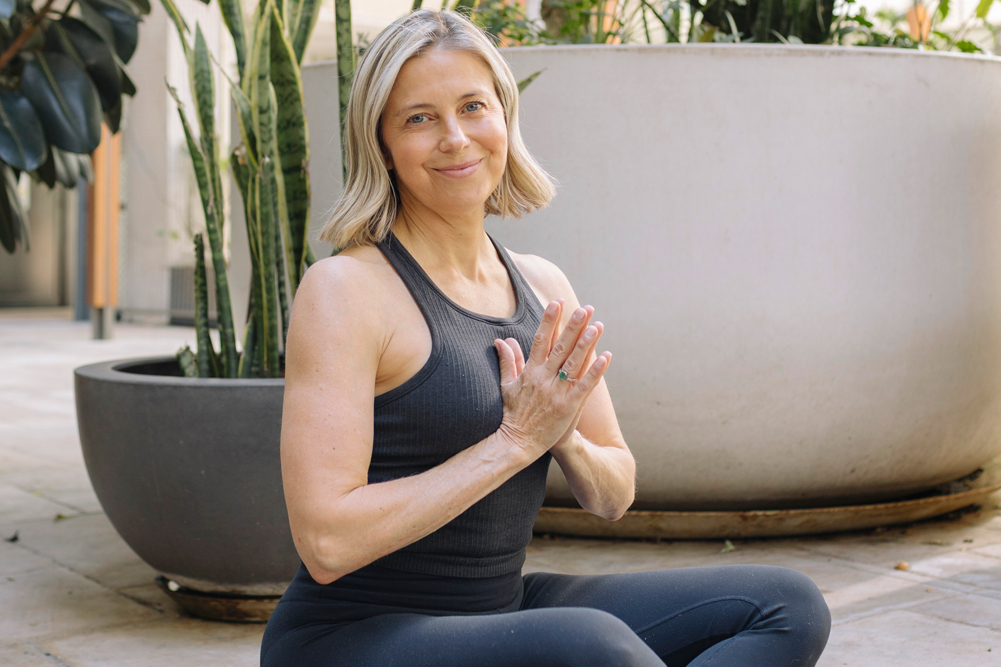
Start in Anjali mudra, hands in prayer at heart. Rotate left fingers towards your heart and right fingers away. Slide the hands until the fingers interlock and on the exhale, pull the fingers apart, keeping the hands at heart level. Chant the Ganesha mantra:
Om gam ganapatayei namaha
Take a few rounds, then relax the hands down, return to breathing as normal and feel the results of the practice.
Journalling
Sit quietly. Ask yourself:
What is asking to end?
What is ready to begin?
What do I choose now, on purpose?
What is my sankalpa for starting again?
Write your reflections.