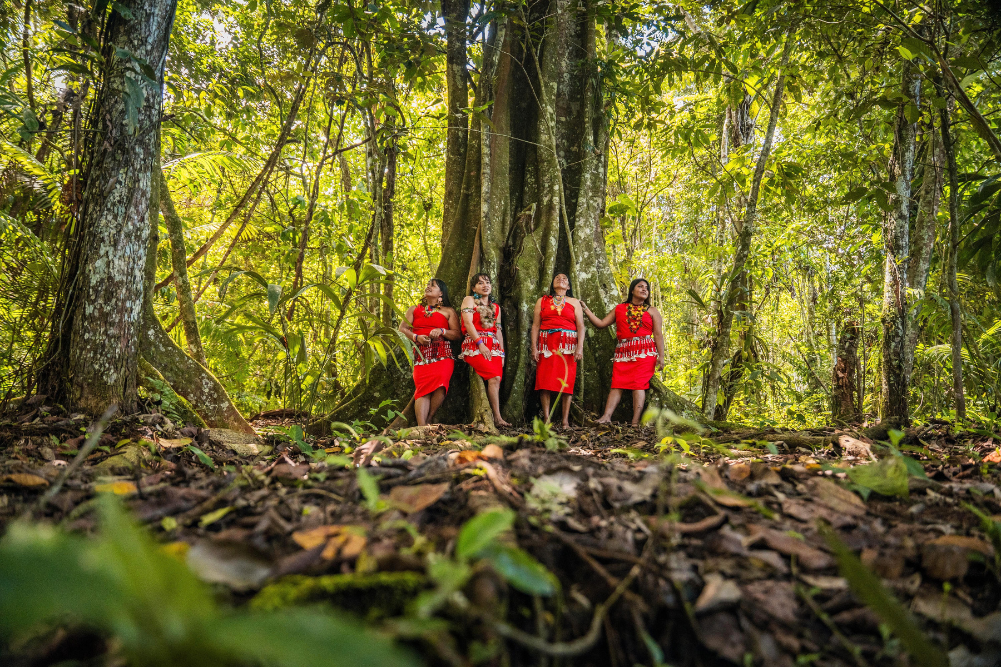
Indigenous Wisdom
Despite the potential trap of generalising about indigenous tribes, the commonalities between these diverse peoples highlight intriguing shared ideas and concepts that keep cropping up in tribal settings, regardless of where in the world these cultures are found.
Tribal peoples represent just six per cent of the world’s population, but they own or manage more than a quarter of the land surface. What distinguishes these groups from the dominant settler cultures in the countries they inhabit are distinct cultural and social practices, and deep longstanding links to the land where they dwell.
More than 5000 of these different tribal cultures around the world hold a rich collection of diverse beliefs. Despite lacking the analytical technological bent of modern civilisation, such groups do benefit from sophisticated ways of looking at the world, which can make reductionist science look fairly simplistic in comparison.
Environmental stewards
Tribes generally feel themselves to be embedded within their landscape and environment, to a degree that Westerners find difficult to understand. Highly sensitised to their surroundings, they often have a knowledge of nature acquired over centuries or millennia, and passed on through the generations.
Seeing themselves as stewards, looking after the country is paramount. They consider themselves as a strand of the web of life, rather than sitting at the top of a hierarchy. Within this kinship orientation towards the environment, plants and animals are seen as relations. This sheds light on a theme within indigenous thinking that crops up repeatedly: that of interconnectedness. The Earth is treated as a living being.
In recent years, there has been a lot of attention given to the Rights of Nature movement. This challenges the dominant Western model of nature as human property, which facilitates environmentally destructive development models. The movement first received widespread attention in 2008, when such laws were incorporated into the Ecuadorian Constitution, guided by the perspective of the Quechua people of the Andes.
Society and culture
For indigenous cultures, the world is often a web of relationships that link the living with people who are no longer alive (the ancestors), and the natural surroundings. These connections are frequently reflected in relatively egalitarian power relationships. Tyson Yunkaporta, founder of the Indigenous Knowledge Systems Lab at Deakin University in Australia, sees the self-organising systems for social organisation that are common among indigenous tribes as being naturally non-hierarchical.
Human nature shares common features across disparate cultures, and one element of this is finding ways to manage potentially destructive emotions. The Inuit (inhabitants of the Canadian Arctic formerly known as Eskimos) have a tradition where people experiencing anger walk away from the settlement in a straight line with a stick. They continue until the anger dissipates, and then push the stick into the ground before returning. Outward expression of anger, or even irritation, is seen as a negative, while calmness, balance and emotional regulation are all valued qualities.
Wetiko is a Native American term originating with the Algonquian peoples, indicating a malevolent cannibalistic spirit that causes individualism, ego and a lack of empathy, manifesting in greed, excess and selfish consumption. An affected individual places themselves outside of society and their ecological surroundings. Wetiko, which is contagious, can be equally applied to cultures and systems, and Native Americans saw it as intrinsic to the settler culture that surrounded the reservations where they were placed.
Work and reciprocity
Indigenous groups living traditionally are characterised by an absence of capitalistic systems, competition and individual self-interest. The primacy of unconditional individual freedom is generally subsumed by membership of the tribe. The number of possessions held by an individual is limited, and most items will have a practical or spiritual purpose. For groups that are semi-nomadic, unnecessary possessions are burdens.
An important element is reciprocity, the habit of doing things for other tribe members, without remuneration, and in return expecting the same.
Reciprocity strengthens community ties, and increases the chances of survival in adversity. At a broader level, it characterises tribal interactions with nature. In and around the Trobriand Islands of Melanesia, the Kula exchange involves long-distance travel by canoe in order to pass on decorative adornments such as shell necklaces and shell bracelets. These symbolic gifts are reminders of a reciprocal relationship of mutual obligation.
On the Pacific Northwest Coast of North America, tribes held a feast known as a potlatch, where giving away or destroying valuable items was viewed as a show of a leader’s wealth or power. One interesting angle to this is the distribution of resources as an anti-hoarding measure, given that in tribal societies, the act of hoarding by an individual was often seen as a sign of pathology.
In the 1960s, an anthropologist named Richard Lee spent time with the Ju/’hoansi Bushmen of the Kalahari Desert in Southern Africa. The society was egalitarian, and characterised by sharing and cooperation. Work took up a limited time (12 to 19 hours a week), was not considered a burden or toil, and those who did not participate were not considered freeloaders.
A non-material realm
Belief in the existence of a parallel non-material world is widespread among indigenous peoples. This realm is inhabited by invisible spiritual entities and beings, including tribal ancestors, and it is widely considered to have a symbiotic relationship with the physical world.
Among such tribal groups, beliefs frequently involve animism (the idea that everything in nature has a soul or spirit), and pantheism (divinity is inherent in the natural world). In indigenous circles, there is usually a conception of the sacred, and an awe towards the mysterious. Among Native Americans, the Lakota term Wakan Tanka, the “Great Spirit” or “Great Mystery”, refers to the power and sacredness inherent in everything.
Sometimes a vital force is believed to animate everything. In Melanesia and Polynesia, it is known as mana; the Kogi people in Colombia call it aluna; and the Algonquian of North America refer to it as manitou. Outside the tribal realm, it has similarities with Hindu prana, and Chinese chi/qi.
Many different kinds of divination occur across indigenous cultures. Dreams can be seen as messages from the spirit world or the ancestors, and some tribes use the messages they convey to guide everyday life. The behaviour of animals in dreams and waking life may be interpreted as omens.
Ritual and ceremony play an important role, and are tied to the tribe’s spirituality. Ceremony can be a means of connecting with ancestral wisdom and transmitting knowledge. It is also a way to maintain equilibrium within individuals, within the tribe, and between the tribe and nature.
Holism
As a contrast to the materialist-reductionist bias of modern society, indigenous perspectives are often holistic. Culture, social life, and more cosmic considerations are all considered to be entwined rather than separate. Knowledge is not compartmentalised into narrow areas of specialism. Component parts make little sense unless viewed as part of the big picture. An indigenous approach to science places importance on relationships and interdependence, with thinking that transcends binaries.
Unlike traditional Western science, which saw the observer as dispassionately aloof from what is observed (before being overturned by quantum
physics discoveries in 1927), the more embodied and grounded indigenous perspective sees humans as intrinsically connected to the world, with the notion of a disembodied observer a nonsense.
Balance and harmony are important, and are reflected in practices such as the Native American honouring of both the female and male principles. Indigenous ideas of balance extend to the field of ecology, and living sustainably within the environment. In tribal circles, sickness and being out of sorts are often viewed as perturbations in a state of harmony.
Indigenous concepts of time are very insightful. Unlike the linear one-dimension time arrow of Western cultures, it is usually seen as cyclical,
recurring, spiralling, and recalling itself. The most obvious example is the rhythmic recurrence of the seasons. The Māori symbol of an unfolding fern frond (koru) can be used as a metaphor for a non-linear way of viewing time, a constant expansion and evolution that mirrors the unfolding
of the cosmos. For Australian Aboriginal cultures, the past, present and future are considered to exist at the same time, embedded within the
Dreaming, a concept that was named “everywhen” by anthropologist William Stanner. This ties in strongly with Yunkaporta’s concept of “deep time thinking”, which takes the long view, looking at the connections between Aboriginal cultures and the land, over tens of thousands of years.
Oral culture
Unsurprisingly, indigenous cultures and myths are orally transmitted. This requires an exact recall of every detail in the original, at every link in the transmission chain, otherwise the story would become degraded in a “Chinese whispers” fashion.
Face-to-face storytelling, which is so important in indigenous circles, has largely been abandoned in affluent countries. However, in Australian Aboriginal culture, “yarning” plays a key role. This form of storytelling is a way to pass on cultural knowledge, and can also involve holding attentive conversations. In Yunkaporta’s view, knowledge is inseparable from relationship. He sees oral transmission as the only durable means of transmitting knowledge across long reaches of time.
Person-to-person transmission of knowledge downplays the abstract and intellectual, and is more embodied and experiential. Learning by doing
trumps learning by rote. Oral culture ties in with the indigenous orientation towards framing reality as a process rather than something static.
Storytelling has been found to mould behaviour in a way that supports the continued thriving of the tribe. A 2017 study in Nature Communications analysed 89 stories from hunter-gatherers in South-east Asia and Africa, and these were found to promote cooperation, egalitarianism and respect for both genders.
Insights from language
Indigenous language is closely linked to culture, and the physical and spiritual environment. American writer Barry Lopez observed that the language of the Inuit comes alive when they are engaged in traditional activities in the wild, where there are words to describe everything, including many words for different types of snow.
Language is a glue that holds indigenous cultures together, reflecting their way of thinking. American author and educator Martin Prechtel believes that culture derives from language, and that characteristics of language can be lost due to pressure from outside Westernising forces. This is not just about native speakers being dissuaded from using it. Prechtel gives an example of Tz’utujil in Guatemala, which lacked the verb “to be”. When it was introduced into the language by the colonising forces, the culture quickly unravelled. Formerly, identity was only established
through one’s relationships to others, but after the change this no longer applied.
Some indigenous languages such as Ojibwe in North America are verb-based, in that they refer to what things do rather than what they are. Verbs convey energy in motion, and this reflects cultures that acknowledge transience and do not assume the existence of a state of permanence. In contrast, a language such as English is oriented toward thinking in nouns.
Yunkaporta also points out that in Aboriginal languages, time and place are usually the same word. While this makes internal sense to the language user, it can be baffling to outsiders.
Preserving culture
At a time when many indigenous languages are threatened with extinction, along with the history and culture that they are bound up with, others are being saved from disappearance through the efforts of determined individuals. Similar eff orts are being made when tribes themselves are at risk of vanishing. Knowledge is being preserved via eco-cultural mapping and eco-cultural calendars. Equally significant is the preservation of indigenous sacred sites that serve as physical gateways for traditional cultures.
It needs to be recognised that much indigenous thinking is deeply at odds with Western culture. Central to this is the idea of decolonisation, in this case distancing from an imposed belief system that is alien to a tribal perspective.
In his book Arctic Dreams, Barry Lopez described Inuit who seem “clumsy, irresponsible, [and] lethargic” when living in villages, but when away from civilisation in the wild, they are “astoundingly skilled, energetic, and perspicacious”.
Living in and out of alignment with one’s traditional cultural heritage can have profoundly differing effects. Where tribal groups are allowed to continue thriving, they off er a powerful role model of how humans can live a deeply meaningful life when integrated into the environment they inhabit.
Martin Oliver is a writer and researcher based in Lismore.
This article is featured in WellBeing Magazine 224