Taking Control
WellBeing reader Vanessa Sewak was diagnosed with breast cancer at a point when very little felt within her control. She found her way back through a weekly exercise class designed for breast cancer patients: six other women, a stationary bike, and the relief of finally being in a place where she didn’t have to say she was fine.
What will my future be? Why did this happen? Will my life be the same now? These are some of the questions that raced through my mind when I received the devastating diagnosis of breast cancer.
When you are diagnosed with cancer, you can sometimes feel like an immigrant in a new country. The familiar is replaced by the new. Everything is suddenly scary and alien. There are so many things you need to learn, and most people who surround you just don’t seem to understand how to communicate with you. Very few have shared the same experience.
Being diagnosed with cancer changes everything. It’s a shock. You are no longer part of the normal world, but rather, a “patient” to be cared for by kind-hearted people who secretly hope to never become you. Your certainty that life is generally predictable is completely obliterated. Never again can you be sure that an unexpected or unlikely terrifying event won’t happen to you or your loved ones. Very little is within your control.
In this situation, a sense of control feels so empowering. I find that exercise provides me with a way to take control over my life at a time when so
much is unpredictable. Recent research has indicated that exercise is instrumental in both leading to fewer side effects during cancer treatment, and potentially improving the long-term outcomes of cancer patients.
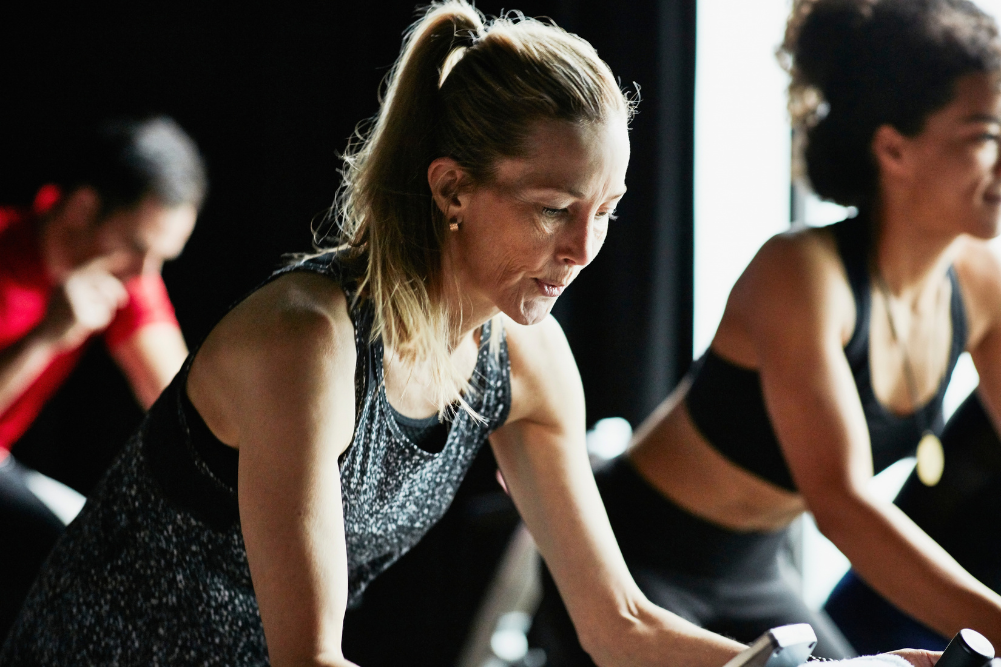
But mental health is also a winner when it comes to exercise. While pedalling an exercise bike, I find my worries dissipate. The feeling of power I experience after noticing an increase in fitness causes my spirit to soar. It is a nice counterbalance to the powerlessness I feel when confronted with the vagaries of breast cancer.
Every Tuesday, I attend a group exercise program, one of many throughout Australia, tailored to breast cancer patients, along with six other women. Together, we huff and puff, while exchanging tales of progress and venting our frustrations at the position we find ourselves in.
The opportunity to be able to do this is monumental. Before joining the exercise class, I hadn’t fully factored in how valuable the social connections would be for mood management. Exercising and sharing tales with others who have had similar experiences is a powerful way to deal with the dark thoughts which swirl through my head. After each class I feel as if I have been pulled out of the abyss of darkness, back into a world where hope still exists.
In our society, acknowledging that you feel anything other than great is often frowned upon. When the sales assistant at the supermarket asks cheerfully, “How are you today?” the default response is, “Good thanks, and you?” She doesn’t really want to know that you tossed and turned last night, anxiously awaiting a scan result, or that you feel like an altered person now that your treatment has led to hair loss and the gradual, cruel disappearance of your eyebrows and eyelashes.
When your family and friends enquire, “How are you going?” the looks of concern on their faces tell you that they can only handle hearing a portion of what you really want to tell them.
The safest place to feel angry and vulnerable is in the group exercise class. Here I can furiously pedal the exercise bike and vanquish the grey clouds that have gathered in my mind. I can express to my new friends my true feelings of disbelief and disappointment in my situation, and even in the well-intentioned but misinformed reactions of some of my oldest and closest friends. When people I have known for many years treat me as a fragile cancer patient to be pitied rather than a friend going through an incredibly tough patch, I feel like yelling, “I’m still the same person; I haven’t changed! Can’t you see me?” Instead I smile politely and remain silent.
In the exercise class I don’t feel falsely categorised. Here, I am treated like the person I am. I can vent and express my frustrations with abandon. My exercise classmates have experienced some of the same disappointments I have and nod in agreement with many of my sentiments. The combination of endorphins released by the exercise and the ability to, for once, be brutally honest is intoxicating.
In this class I have met women who have given me permission to be my true, flawed, sometimes unhappy self. This is a gift and truly liberating. My only regret is that it took breast cancer to get me to this point.
This article is featured in WellBeing Magazine 224