A Vegan’s Guide to Penang
Here in Penang, locals have a reputation for talking endlessly about food, planning their days around what to eat and where. So when our taxi driver discovers that our bellies are still empty at 1pm in Penang, he takes it upon himself to set things right.
Guiding us on a gastronomic side trip, he detours to the best street stalls, cafes and eateries en route to Georgetown, slowing down to point out another place worth eating at, with instructions on when to arrive and what to order.
That he’s dealing with a car full of non-meat eaters doesn’t faze him at all, because we have happily arrived in a vegan wonderland. Thanks to its rich Chinese Mahayana Buddhist heritage, this eccentric island panders lovingly to vegan tastebuds with a faux-meat cuisine that turns the tables and hands vegans the whole menu.
Often called temple food or su zhai, this compassionate, plant-based cuisine is normalised in Penang — a way of eating that was originally designed for sixth-century monks and has since spilled out into the streets.
That it flourishes in Penang is no surprise. This island state, with a long heritage that incongruously includes eras of British settlement and Chinese opium trading, is one of the most tolerant places in Malaysia. In an otherwise multicultural country, Penang’s Chinese heritage is everywhere — from the streetside bars where beers are served by white-singlet-wearing old Chinese guys, to the glittering Buddhist-Tao temples.
Our taxi drops us kerbside at Kuan Yin Teng, the Temple of the Goddess of Mercy, all aglow with candles and swathed in incense smoke. “Pray first, then eat,” our driver laughs, “but don’t linger too long or the steamed buns will run out.”
We slip off our sandals and tread across the cool, tiled floor, lighting our just-bought pink lotus candle in honour of the goddess who dwells in temples right across the island.
The goddess of mercy
Kuan Yin is Penang’s most revered Buddhist deity, and she doesn’t just dole out mercy; she’s known for bestowing peace, good fortune and fertility, too. There are other, far more flamboyant dedications to the goddess elsewhere in Penang — in fact, the island’s most prominent hill is crowned with an astonishing 36m-high statue of Kuan Yin.
Yet none is as old or as peaceful as Kuan Yin’s busy little Georgetown temple, where locals come to wave smoking joss sticks and send their wishes skyward. Past the rows of candle sellers at the entrance, beyond the sand-filled censers into which worshippers plunge their lit joss sticks, we discover a beautiful breezy alcove that recounts the temple’s full history in English and a peaceful little back garden fragrant with flowers.
It becomes a favourite ritual for us in Georgetown to light joss sticks and a candle and sit with the calmness that Kuan Yin instils. Then we stroll on to fill our plates with all-vegan delicacies at Ee Beng Vegetarian Food.
Ee Beng vegetarian
Mirroring Kuan Yin Temple’s authenticity, there’s nothing fancy about Ee Beng — a self-serve vegan cafe designed to fill bellies with healthful, delicious, good-karma food.
We grab a plate, add a scoop of wild rice and begin to top it with spoonfuls of an astonishing choice of just-cooked dishes. There are rich, spicy curries and all kinds of stir-fried vegetables, plus mock-meat turned into every Chinese and Malay specialty you could ever imagine.
We choose salt-and-pepper tofu, peanut satay sticks, mock duck, vegan “prawn” chow mein and minced mushroom mapo tofu. We munch on corn fritters, spring rolls and steamed buns stuffed with mock-barbecued pork — so many choices that, despite our repeat visits, we never get even close to working through all the possibilities.
Thanks to those sixth-century monks who wholeheartedly embraced a meat-free diet, Penang’s take on vegan cuisine offers complex, surprising flavours. With soy and wheat gluten taking on elaborate, mock-meat forms, we discover crispy-skin mock-fish that has both the texture of flaky fish and the appearance of fish scales, and local Nyonya Malay curry rendang, Chinese barbecued mock-pork and vegan Mongolian lamb that all mimic their meaty counterparts.
The mushroom-rich dishes usually avoid the five pungent spices said to disturb the mind — garlic, onions, shallots, leeks and chives. And all these dishes that wow us big time are found in simple cafes clustered around temple sites, fluttering their distinctive yellow-and-red-silk flags.
Eating well in Penang, it seems, has nothing to do with fine dining. In backstreet markets full of street carts we order noodles straight out of the wok and devour them on the kerb, perched on tiny stools. We sit elbow-to-elbow with locals slurping breakfast noodles at pop-up bus stop cafes, and sip our rich Malay coffees from wooden crates, watching the world drift by.
Penang famous samosa
Last year, when I was living close by, I had to visit Penang on business for just one day. To please the family foodies, I flew back home nursing a huge box full of Penang Famous Samosas. This unpretentious hawker stall that sports a single menu of deep-fried treats and Indian sweets sells the best vegetarian samosas I’ve ever tasted — at around 30 cents each.
There are no seats and no drinks on offer, just big trays of freshly prepared snacks. And while there are other deliciously deep-fried vegan treats on the menu — pakodas (shredded vegetable fritters), batter-dipped onion bhajis and spicy lentil donuts called vadai — it’s for the samosas that this stall earns its Michelin Guide mention.
The best way to explore Georgetown is with a bag of samosas in hand, munching your way down bustling back alleys and meandering from one historic site to the next. There are highlights for sure; Penang’s Chinese clan jetties, houses and the floating Hean Boo Thean Kuan Yin Temple are still inhabited by families who eat, pray and live on, and over, the sea.
Clan architecture
With its huge doors and ornate ridged rooftop, the Han Jiang Ancestral Temple is one of the most striking of all Penang’s Chinese clan temples. Built by early Chinese immigrants to support newcomers arriving in Penang from their Chinese homelands, it harbours a secret and peaceful courtyard, richly decorated frescos and inner shrines dedicated to the Taoist God of the North, a patron deity of Penang’s Teochew clans.
Penang’s clans are responsible for constructing and conserving much of the architecture that earned Georgetown its World Heritage status, including the clan jetties that stretch far out over the sea. Built from the mid-1800s, these offered lodging and companionship, helped fresh arrivals find work and preserved customs, culture and language dialects that might otherwise have been lost.
Here, where people live without too many airs and graces, no one seems to mind the tourists who peek through open doors or aim their phones at the grandpas sleeping, the meals being cooked al fresco or the kids clowning about and jumping wildly into the sea.
Goddess on the hill
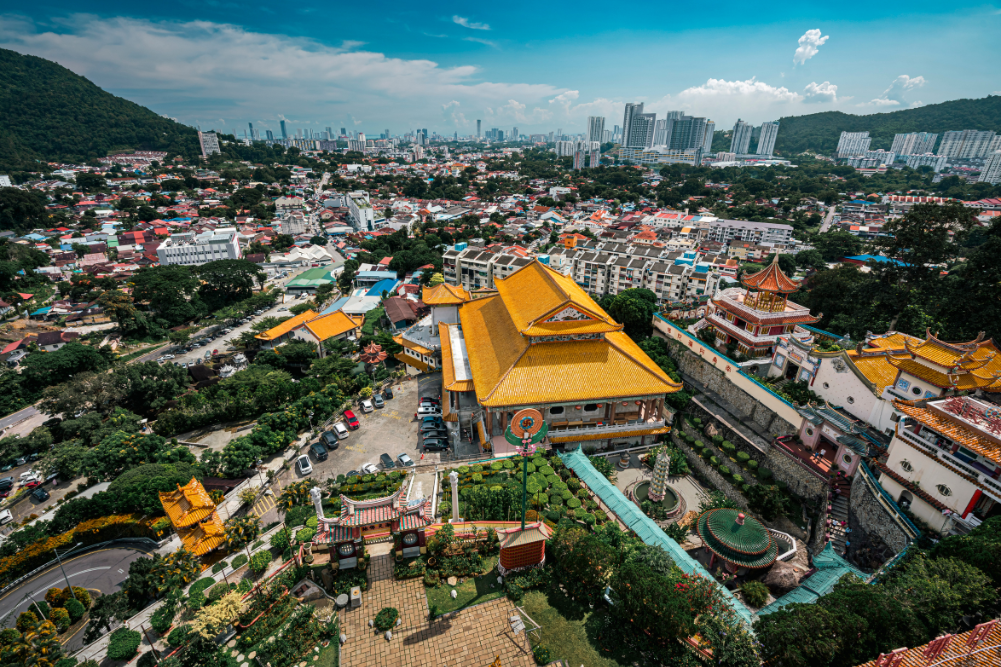
Far from Georgetown, Kek Lok Si is a bustling, brilliant tribute to Penang’s number-one goddess. She sits atop Crane Hill — a peak that auspiciously resembles a crane with outstretched wings — crowning the most famous landmark in Penang and keeping watch over the monastery, halls and temples that make this Malaysia’s largest Buddhist temple complex.
Discovering Kek Lok Si — which aptly translates to “Temple of Supreme Bliss” — requires stamina and time. We swerve around the tacky souvenir stalls and a tightly packed tortoise pond, and climb to the Hall of Bodhisattvas with a lofty ceiling fresco so captivating that we leave with arching necks. Small donations buy us colourful silk ribbons, which we choose for the wishes they bear, hanging them in the breeze to flutter our hopes to the gods.
As we climb ever upwards, we discover great halls and blooming gardens, resplendent shrines and robed monks happily restoring it all. Finally, the goddess beckons us onwards to where her 36.5m-high bronze replica presides over Penang.
More exploring
Nestled at the foot of Kek Lok Si, Purple Stone Vegetarian and I have a history that goes back 15 years. Since that long-ago backpacking adventure, little about this simple eatery has changed and the cuisine is still as delicious as when it first blew away my tastebuds.
My 14-year-old daughter, a lifelong vegetarian, piles up a plate and digs right in, savouring a menu that’s all designed for her. It’s not a small thing to feel so included when you’re a vegan in a meat-loving world, and the vibe of this place washes over us like pure golden sunshine.
Penang’s long list of magical attractions keeps us on our feet for days: visiting a pair of gorgeous temples (Thai on one side, Burmese on the other), taking shaded forest hikes and spending a lazy Sunday afternoon of music, food and art at the Hin Bus Depot Markets.
Here we order organic Malay coffees, icy nutmeg juice and delicious vegan cakes, then traipse through the pop-up stalls selling handmade clothes, collectables and all kinds of earth-conscious original creations. In this thoroughly modern space, we return full circle having eaten our way through the centuries in Penang. And yes, we leave the island with a box full of samosas.
Escape routes
Go
Malaysian Airlines flies to Penang (via Kuala Lumpur) from Sydney, Brisbane, Melbourne, Perth and Adelaide return. Penang is hot and humid year-round, but it rains less and temperatures are less extreme from December to February.
Stay
For accommodation in Georgetown, the lavishly restored Cheong Fatt Tze’s The Blue Mansion (of Crazy Rich Asians fame) offers luxurious double rooms (cheongfatttzemansion.com). Close to the airport and with impressive sustainability credentials, the Olive Tree Hotel suits lovers of high-rise views (olivetree.my). The Edison’s restored colonial-era deluxe rooms come with complimentary breakfast, free all-day snacks and free pre-dinner wine (theedisonhotels.com).
Eat
Ee Beng Vegetarian on Lebuh Dickens, Georgetown; Penang Famous Samosa on Queen Street, Georgetown; Yun Shan Ge Vegetarian House for five-star vegan Nyonya cuisine on Penang Street, Georgetown.
This article is featured in WellBeing Magazine 223