Spirituality in the City
Wandering candlelit streets, climbing ancient temples and dining with new friends, we discover spirituality in some of Kathmandu’s most unexpected corners.
I arrive in Kathmandu to find the city bathed in candlelight, stepping into my hotel over a threshold adorned with flickering flames and intricate mandalas crafted from vibrant coloured sands. At every entrance, whether houses, shops, cafes or hotels, artists are crouched on their doorsteps, patiently perfecting the sacred geometric designs that unite Nepali people to celebrate Tihar, the five-day Hindi Festival of Lights.
My arrival is auspicious. Tonight, Laxmi, the Goddess of Wealth, will flow through city streets to work her magic on each family’s bank balance. I drop my bags in my room and hastily head back outside, joining longtime Nepali friends who bless me with red forehead tikas in Hindi puja (prayer) ceremonies, and ply me with so many sweet treats that my teeth begin to ache.
We crouch together on the curb outside their cafe, crafting mounds of brightly dyed sand into beautiful mandalas and studding them with dozens of tea light candles. We eat, drink and exchange gifts, and when I wander back to my hotel past groups of kids singing on the streets, the karmic energy of so much citywide goodwill is palpable. Despite the icy temperature, I leave the window open and light a single candle for the Goddess who has a busy night ahead of her.
An ancient search
Nepal’s reputation as a pilgrimage site for mountain trekkers belies the fact that Kathmandu is a deeply spiritual place. Fresh off a six-week-long wander through the Himalayan foothills of Mount Everest, known as Chomolungma to Tibetan people, I return to the city renewed and keen to safeguard the calm and serenity I’ve cultivated in those mountains.
But cities can be incongruous places to navigate when you’ve kindled a deep sense of wellbeing, so where and how do you nurture spirituality in any city? I hit the streets to find out.
It’s a little known fact outside of Nepal that Kathmandu was designed by kings. While most cities are built on grids, King Gunakamadeva
designed Kathmandu in the late 900s in the shape of Chandrahrasa, the sword of Manjushri, with eight gates guarding its perimeter where eight important goddesses dwell.
In the centuries that followed, a succession of Malla kings added the palaces, temples and Durbar squares that UNESCO World Heritage listings have made famous, attracting a world of travellers. But even now, it’s those eight sacred gates guarded by the goddesses that resound with the most powerful spiritual energy in all of Kathmandu.
Monkey time
I set out at dawn to climb high above this ancient city, scaling hundreds of steep steps up to Swayambhunath. It might rate as one of the holiest
places in all of Nepal, but it’s better known as the ‘Monkey Temple’ for the hordes of rhesus macaques that claim it as their own.
I hastily finish off the bag of potato samosas I’ve bought for 25 cents a piece from a tea seller below the hill, then brave the marauding monkeys, climbing with a firm grip on my bag.
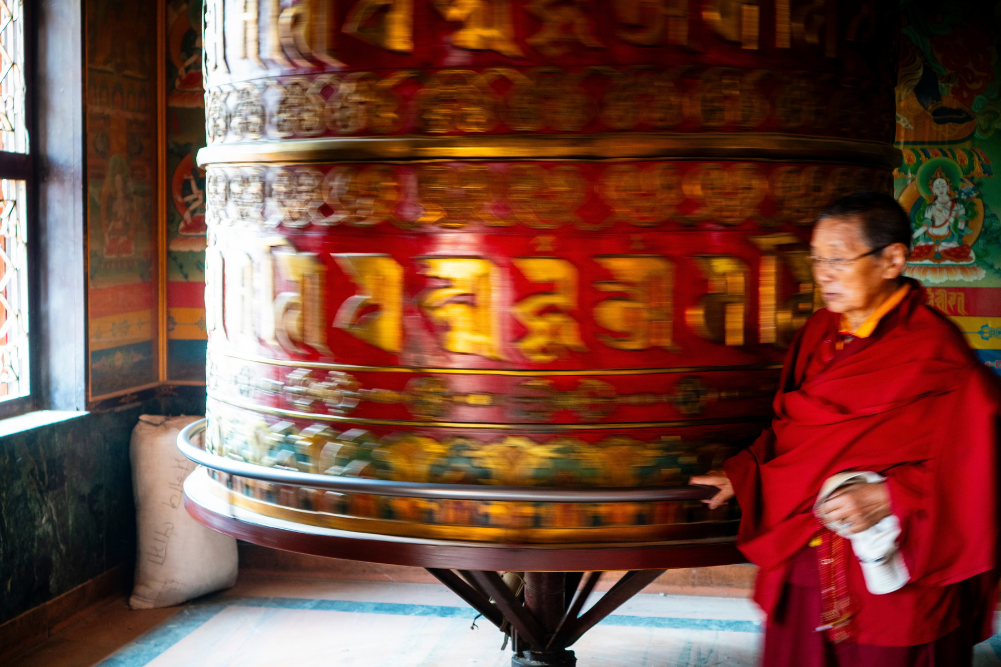
Crowned by a grand Buddhist stupa but studded with Hindi shrines and statues, too, Swayambhunath inextricably intertwines the two religions in a harmonious way that baffles outsiders. The views at the top are literally breathtaking, and I wander clockwise around the stupa, swept up in the flow of prayermakers making pujas for university graduations, happy marriages, healthy babies and more.
Just as I’m feeling absorbed by the collective sense of prayer and hope, a huge macaque jumps on my head, and the sight of me screaming and shaking it off has bystanders in stitches.
On the mat
Much later, once the fear of rabies subsides, I catch myself laughing, too, gazing back at Swayambhunath from the seventh-floor yoga hall atop Kathmandu Guest House. Crowning the hotel, itself a wellness sanctuary in the heart of Thamel’s bustling tourist district, this seventh-floor location is rightly auspicious, paralleling the seventh Sahasrara chakra.
I take it as a sign, melting into my mat after a hot hatha session as renowned yoga guide Kanchan Singh sits cross-legged at the front of the class, playing Tibetan singing bowls in a healing meditation that Nepalis call Dhyana. I’m almost asleep when the last note rings out, so my scheduled interview with Kanchan is a deeply mellow exchange. We sit together on our yoga mats and talk about the universe, about past lives and what my
palm tells him about a big change soon to come.
“If something is to happen, the universe connects you,” Kanchan tells me, adding that I shouldn’t wait for a guru to emerge.
“If a person is searching for something, the universe helps you to find the guide. Anybody can be the guru. Any person, animal, any situation.”
Art for wellness
I ramble around Kathmandu, landing in places I hope might conjure a sense of wellness and peace, and have the kind of unexpected encounters with people I’m sure Kanchan would call guides.
Shaguni Singh Sakya, executive director of Kathmandu Guest House, walks me through MoNA, the Museum of Nepali Art, with the suggestion that understanding art is a meditation in itself.
In this calm, cool gallery of exemplary privately owned works, Shaguni shares her thoughts about art and yoga, and the history of Kathmandu, and all that’s linked to our understanding of physical and spiritual wellness.
“I feel there is so much high energy in Kathmandu because our everyday life is so intertwined with worshipping energy, with worshipping nature,
worshipping animals, kings, worshipping the water, the air,” she says.
“Worshipping the divine in you and that divine that is around you; if that is multiplied by so many people in a city, the energy multiplies.”
Palace contemplation
I set out to join the camera-clicking masses at Patan, one of three ancient Kathmandu Durbar Squares. All are UNESCO World Heritage sites with ornate palaces and pagodas, but Patan’s meticulously restored, extensive museum has me walking its halls for days.
Housed in an old palace built in 1734 on the site of a Buddhist monastery, Patan Museum has risen from the ashes of earthquakes many times in its long history. Its exhibits showcase just about every aspect of Nepali cultural history through halls and walls filled with around 1100 rare religious artefacts, historical photographs, videos, art and more.
I quickly lose my way, popping out into the sunlight at Tusha Hiti, a sunken outside bath with intricately carved stone and wood sculptures. There are secret gardens and courtyards, water ponds, and sacred artefacts revered as the fi nest of their kind.
Outside in Patan Square there are gilded temples aplenty, too, but I escape the tourists and the tenacious guides floating close by to thread my way along deserted backstreets. Here, I find solace sitting quietly at the foot of the terracotta Mahabouddha, adorned with literally thousands of centuries-old engraved images of the Lord Buddha.
Food as medicine
A good friend of mine is a chef in Kathmandu, and while his vegan and gluten-free cuisine thrills foreign trekkers, it’s traditional Nepali food that he loves the most. There is no better way to understand Nepal and Nepali people, he says, than through their cuisine, so I return to Kathmandu Guest House for a curated evening of traditional dishes from across the country, served in a digital art space-cum-cafe.
Like all countries with well-defi ned regional cuisines, Kathmandu’s most craved-for meals have roots in faraway towns, imbued with the fl avours of neighbouring India and Tibet. Newari food, I soon discover, is entirely different to Thakali cuisine, and the offerings of Nepal’s diverse ethnic groups are delicious.
The evening’s meal consists of five distinctly different courses: Sisnu Ko Jhol, an earthy-flavoured soup made from Himalayan nettle; a Thakali platter from mountainous Mustang comprised of lentil dhal, curry, rice, beans, Mustang potatoes and organic salad; Newa Samay, a Newari savoury pancake served with black-eyed beans; Anda Chwohi, a delicate steamed egg custard from Patan; and from Bhatktapur, a silky yoghurt dessert with a hint of cardamom called Shikarni.
Our guide for the evening is Kathmandu Art House curator Rasna Shresta, who interprets the menu, highlighting each dish’s origins and the traditional and medicinal flavours contained within. The night’s menu is a revelation to me after six weeks of same-same trekking lodge fare, and thoroughly nourishing in every way.
Coming full circle
Wellness, Shaguni Singh Sakya tells me, is like a divine calling, an inner awakening that’s not just emotional or physical. Once you start moving towards it, you find it in all kinds of unexpected places. To yoga guide Kanchan Singh, wellness and happiness are about connecting to yourself.
“I don’t want people to be perfect on asana, I want them to smile, I want them to feel their breath. I want them to know who they are,” he says.
In Kathmandu I find this wellness that I’ve been seeking on the yoga mat, on sweaty climbs to lofty temples, and standing at the gates of an ancient city where goddesses dwell. But I also find wellness in the quiet contemplation of works of art, and finally, happily, at the tables of dear friends, eating good food made with love. I may not have found it on my own, but as it turned out, the universe didn’t just send me a guide in Kathmandu; it sent me many.
Go
Flights to Kathmandu depart all Australian capital cities, via Kuala Lumpur, Singapore or Bangkok (advance fares from around $800 return). Try Thai Airways (thaiairways.com), Malaysian Airlines (malaysianairlines.com) or Singapore Airlines (singaporeair.com).
Visit
To avoid the worst of winter and the rainy monsoonal months, visit in spring (March to May) or October to November for clear skies and milder temperatures.
Stay
Kathmandu Guesthouse provides airconditioned suites, deluxe and standard rooms (from around $78/night, ktmgh.com). Just outside the city, Shivapuri Heights Cottages offers cottages, rooms, safari tents and a Mongolian yurt, starting from $114/couple/night, breakfast and wifi included (shivapuricottage.com).
Do
Kanchan Singh leads hour-long hatha yoga, ashtanga, hatha vinyasa and sound yoga sessions daily in Thamel at Kathmandu Guest House (priced from $12/person). Swayambhunath is located 3km and within walking distance from Thamel (entry costs around $2.50/person). The Immersive Dining Experience at Kathmandu Guest House includes a tour of MoNA and Kathmandu Art House (5pm daily, around $50/person). Patan Durbar Square is located in Lalitpur, a short taxi ride from Thamel (open daily 10.30am to 5pm, entry costs around $12/person).
This article is featured in WellBeing Magazine 224