Yoga for Strength
There is nothing quite like first love. That innocent, blind adoration of the seemingly flawless object of your affection. I’m not talking about the one you secretly kissed on your movie date or wrote about in your diary. Rather the thing you fell hard and fast for in your activewear. Perhaps it was yoga, like me, in the pre-social-media days of daily practice and no Insta story to prove it. Or running, before watches and Fitbits told you how well you did. Whatever it was, there was likely a movement practice that always gave you a feeling nothing else could. For many of us though, at some point that great love just doesn’t meet all our needs anymore. Life changes, and so do we, and as these miraculous vehicles carry us through each season, we must service them in different ways. So instead of expecting one form of movement to be everything, we turn elsewhere or look for more balance. The research now supports this idea, suggesting that a mix of different movement modalities is more beneficial for our overall health than just one. Perhaps that’s what our intuition has always known and been telling us in its own clever way.
Evolution from the mat to the gym
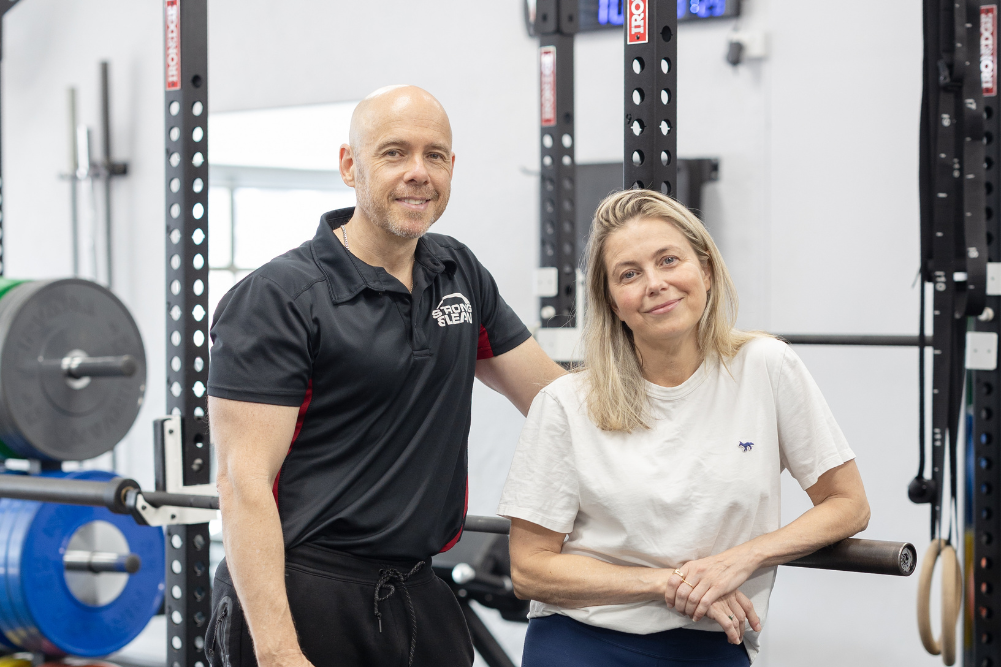
In my 20s and 30s, I was obsessed with my first love. I gave up late social nights for morning meditation and yoga in the shala, spending two hours on the mat most days before work and life. I did inversions until my 38th week of pregnancy and used pratyahara, meditation, chanting and breathing techniques in labour and the postnatal period. But once my son was born, life changed. I became a single working mum and long, heavenly savasanas (on the mat or in bed at night) were a thing of the past. Practice was non-existent, and I found myself time-poor, anxious and exhausted, looking for movement that prioritised strength and grounding, which I needed more than anything else. I swapped out asana for weights with an amazing trainer, Brad Stocks, and slowly began to feel physically and mentally strong again. But the gym alone just didn’t cut it in terms of bringing me back home to myself, so eventually I stepped back onto my mat in the moments I could, the mix of the two being the perfect combo I still lean on today.
Why strength train?
This personal evolution coincided with a synonymous shift in understanding women’s health. Much of my generation avoided lifting weights, worried we would become bulky. Instead, many spent countless hours on treadmills and cross trainers. In recent years, the research suggests resistance training is one of the key things we should all be doing throughout adulthood and as we age, especially women. It helps preserve muscle mass, maintain bone density, improve metabolic health and reduce our risk of falls. All these things become increasingly valuable through perimenopause and beyond. Lifting weights isn’t about getting bulky or booty, it’s about remaining capable, independent and resilient for the decades ahead.
More alike than we think
The more time I spend on the yoga mat and in the gym, the more similarities I observe between the two. Brad and I have had endless conversations about movement, mindfulness and the connection we both see across yoga and strength training. They ask us to become completely present; anyone who has attempted a heavy squat or a headstand knows there is very little room left for running through your mental to-do list. In yoga philosophy this quality is known as dharana, the practice of concentration, or one-pointed focus. For a few precious moments in the gym or o the mat, the chitta vrittis, or whirlings, of the mind described by Patanjali are interrupted and begin to settle as we try to get that last bench press or backbend done. Both modalities invite conscious use of breath, to activate the core and manage the central nervous system, switching between sympathetic and parasympathetic states as required.
If you’re like me and you do small group training and studio classes, they give you the gift of community. And they cultivate tapas, the inner discipline that transforms us, asking us to show up again and again, especially on the days we really don’t want to. Vitally, to stay with sensations and experiences we want to back away from, to remain steady when the going gets tough and things feel challenging. They invite the practice of acceptance, showing exactly where we’re at and what we need to work on. Neither has shortcuts; rather, progress happens pade, pade, step by step. They teach us non-attachment and humility. They are synonymously wondrous at showing us we are way stronger and more capable than we think. And no matter how resistant we are to showing up on any given day, we very rarely regret it when we do. Because something happens to us at a cellular level when we step away from our lives into these spaces to move and breathe consciously together. We leave feeling changed.
Brad reflects that this happens because the mind-body connection is profound, explaining that movement can release stored trauma, referencing the work of Bessel van der Kolk. “Strength training helps move people out of their amygdala into their prefrontal cortex, where they can think more clearly and problem-solve, especially when breathing is a focus.” But he also agrees that yoga provides parasympathetic nervous system and vagal toning on a deeper level for people, allowing for a powerful internal reboot training doesn’t necessarily off er. With a bachelor’s degree in counselling, as well as more than 20 years’ experience in the health and fitness industry, he is particularly motivated by a desire to support individuals not just physically, but psychologically, especially men. We know men’s mental health is in crisis worldwide, impacting over 40 per cent of the male population in Australia at some point. And he concurs that adding yoga and mindfulness into the mix can positively impact our overall wellbeing in a way training alone doesn’t.
Adding some sugar to your coffee
One of the central themes of yoga philosophy is the equilibrium of opposites. In the Yoga Sutra, Patanjali reminds us that practice should cultivate a balance of sthira sukham asanam, steadiness and ease, or stability and sweetness. This is where yoga can complement strength training, by being the yin to its yang, the moon to its sun. Yoga practices are varied, dynamic or gentle, depending on what each individual needs. So if you’re already lifting weights three or four times a week, a heating vinyasa class that builds more sthira may not be for you. Instead, what may be is adding some softness to your tightness, some sugar or sukha to your coffee, knowing the evidence suggests this diversity in movement is more valuable for your wellbeing than strength training alone. A cooling, restorative or yin practice centred around mobility, conscious breathing and longer-held postures could be just the counter you need to fi nd your equilibrium.
More than stretching
When it comes to muscles, there is value in having balance rather than too much of the same. Strength training asks muscles to repeatedly contract, but muscles were designed to both shorten and lengthen. If you’ve spent a session squatting, lunging or deadlifting, your hips, quadriceps, calves and glutes have worked at contracting hard, as have your arms, back and shoulders if you’ve pressed and pulled. A complementary yoga practice restores mobility through these areas, encouraging tissues to stretch and move in ways they may not when we train to strengthen
Increasingly we’re also learning that healthy movement means understanding the role of fascia, the connective tissue that surrounds and supports each muscle, bone, organ and nerve. Strength training loads the fascia in purposeful ways, encouraging adaptation and resilience, while yoga introduces different ranges of motion and slower transitions, encouraging the glide of those tissues, restoring hydration and mobility through the joints. And the longer sustained holds help rebuild collagen and improve elasticity.
This doesn’t mean we need to find another hour we don’t have to get to a yin or restorative yoga class (though it would provide excellent benefits for most of us, I can assure you). Even a mini practice at the beginning or end of a session may be enough to provide immense benefit.
Before or after?
There is some contention over whether it is better to stretch or do a yoga practice before or after a strength session. Strength training naturally prepares the body for action, so the heart rate rises, blood pressure increases, breathing becomes stronger and more purposeful, and the nervous system becomes more alert. This is appropriate when we’re asking our body to lift something heavy. Current research suggests that prolonged static stretching immediately before heavy lifting may temporarily reduce maximal force production. Instead, pre-gym, think dynamic stretching like shoulder rolls, leg swings and lunge walks. Mobility work and longer-hold stretching is more likely to be beneficial after training, when the focus shifts from preparing the body to perform towards restoring movement and range.
For many years, stretching immediately after exercise was thought to be an important part of recovery. However, reviews over the past decade suggest that static stretching by itself has only a small eff ect on reducing delayed-onset muscle soreness. Interestingly, a 2025 study comparing 15 minutes of yoga with 15 minutes of stretching following intense exercise found that the yoga group experienced a faster reduction in respiratory rate and greater improvements in HRV, or heart rate variability, during the recovery period. This suggests a stronger parasympathetic response. While researchers are still exploring exactly why this occurs, it makes sense that combining mindful movement, breath and focused attention might influence the body differently to simply stretching in isolation.
Strength training and yoga are not the two unlikely friends they may seem; in fact they complement one another. With practice, space is created where there is tightness from working hard, flexibility where there is rigidity, and receptivity where there is force. We leave the weights on the gym rack and allow the weight of the world to slide off our shoulders, embracing both the sthira and sukha that bring us true power and peace.
The practice
This mini practice can be done immediately after training, or later that day. Focus on keeping the breath expansive, gaze down the tip of the nose or close the eyes and dive into the stillness.
Tadasana to side stretch
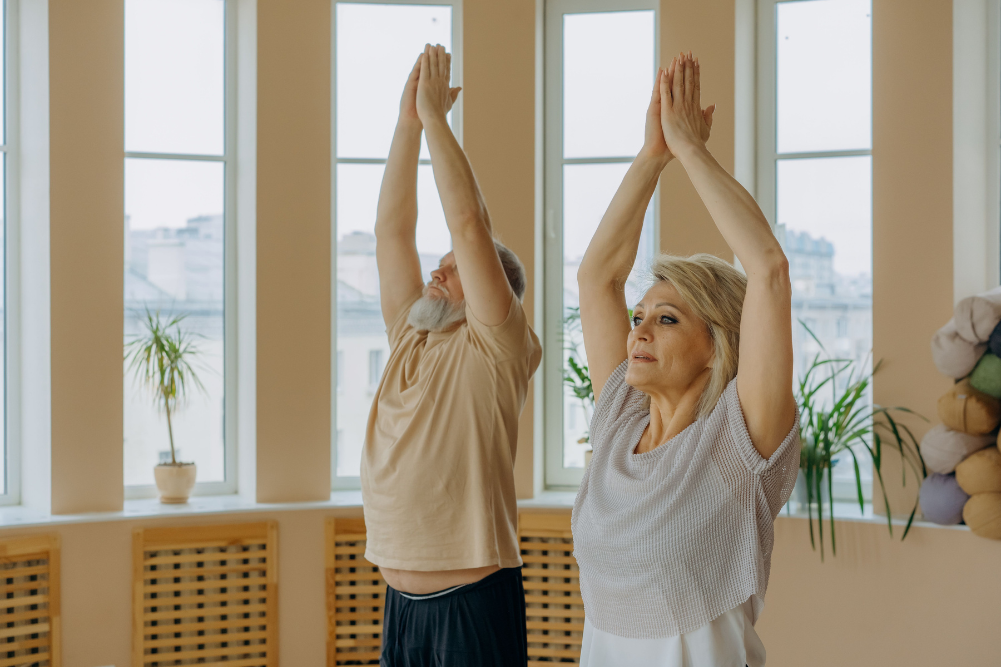
Stand with feet hip-width apart. Relax the navel and lower belly, breathe in through the nose, expanding the lower ribs and belly on the inhale, and slowly breathe out through the nose as the belly moves back in. Relax the jaw, face and shoulders and repeat these full breaths two more times. Next, inhale, reach the arms out to the side and up, catch the left forearm with the right hand and take a side stretch over to the right, grounding the left foot. Take a few breaths and swap to the other side. Come back to tadasana. Standing forward folds and spinal roll Take the chin to the chest and roll down, vertebra by vertebra, softening the knees as you do. Catch the elbows, knees soft, upper body hanging. Take a few conscious breaths and if the lower back is well, gently rock the elbows side to side.
Release the elbows, bend the knees, lift the chest and interlace the fingers behind the back. Fold forward once more and reach the arms overhead, extending the legs a little or a lot. Take the feet a little wider if needed, then three to fi ve slow, expansive, even breaths.
Release and slowly roll up vertebra by vertebra, stacking each one upon the next until you come to stand once more.
Lizard lunge to quad stretch to optional pigeon and half splits
Hands to earth, step the left leg back. Hands or forearms down. Lower the back knee to the ground and open the right knee out to the side for a few breaths, coming to the outer edge of the right foot. Bend the back knee and maybe catch the foot or ankle with the same or opposite hand, to add a quad stretch. Take a few breaths. Release the back leg.
Option for half pigeon or deer. Take the right shin down, knee in line with the hip, shin as parallel to the front edge of the mat as possible. Either support the pelvis so it is even, or bend the back knee into deer pose. Fold forward and breathe. We know the fascia likes a good few minutes of holding stretches in this way, so if you have the time, set yourself up so you can stay here for a few minutes on each side.
Bring the right foot a little more to centre, extend the right leg for a hamstring stretch, maybe folding forward for a few breaths. Swap and repeat on the other side.
Caterpillar pose
Come to sit, legs extended, feet hip-width or a little wider, and fold forward over the legs. Support the upper body so you can relax down. Hold for a few minutes, focusing on lengthening the breath.
Cat-cow to downward-facing dog to puppy pose
All fours, shoulders over wrists. Inhale, slide the shoulder blades down the back and open the chest; exhale and reverse, spreading the shoulder blades apart. Take a few breaths. Walk the wrists in front of the shoulder line, tuck the toes and extend the legs for downward-facing dog. Bend one knee at a time, then keep the knees bent or extend the legs and breathe. Knees down, hips over knees, walk the hands forward and descend the chest and forehead down for puppy pose.
Gomukhasana hips and shoulders
Stack the right thigh over the left, sitting between opposite feet. Sit on a block or extend the left leg if required. Option to add the shoulders here or do the arms separately while kneeling. Inhale, sweep the arms out and up, bend the right arm and try to scratch your upper back, bringing the elbow straight up if you can. Move the head back into the arm. Take the left hand to the right elbow to encourage the stretch, or bend the left arm to catch the right fingers. Breathe and swap.
Sphinx pose
Take the forearms to earth or a bolster and stretch the whole front body, climbing the chest up, shoulders away from the ears.
Reclined heart opener
Recline with the upper body on a bolster or blocks, either with the knees bent for saddle pose, or the soles of the feet together and knees out to the side for supta baddha konasana, for the hips or a quad stretch.
Happy baby to supine twist
Lying on your back, bend the knees, catch the feet and encourage the thighs down to earth, either side of the ribs. Support the head with a block if it lifts. A few breaths, then bring the knees together and drop them over to the left, twisting to the right, keeping the right shoulder blade down. Breathe and swap.
This article is featured in WellBeing Magazin 225