Yoga for Grandparents
A yoga teacher fractured her kneecap in a Sydney car park on the way to the airport, then spent six weeks in Paris being wheeled through galleries by her 12-year-old son. The accident taught her, again, what the practice has always been about. A piece on yoga for older bodies, with a chair-based sequence you can try with the grandkids.
I have been reflecting on the ageing process lately, having had a significant birthday milestone last year. The day I was flying to Paris (I had lived
there in my youth) with my then 12-year-old son in tow, I tripped over in a car park and fractured my patella (kneecap). We delayed the fl ight by a day.
I went to emergency, was put in a hefty brace (which meant my leg stayed straight 24/7) and given blood thinners so I could fly. The next day we departed, my son pushing me through the airport in a wheelchair, managing our enormous suitcases (and emotions), and our relationship flipped. He took responsibility for the lion’s share of physical logistics over the coming weeks. In France, I hobbled along cobbled streets with my cumbersome appendage; he wheeled me through galleries, navigating Easter tourists unwilling to budge, and so we moved slower and did less than planned.
As we sat in cafes, played cards and people-watched, I felt gratitude for this slower, more connected time with him, knowing he was off to high school next year and these moments would be fewer. And I was reminded of what yoga was really about: letting go, non-attachment, presence and connection.
Humility and presence
It was humbling to lose my independence and disappointing to be back in a city I love and know well, unable to do what I used to do with ease and pace. It was a big lesson in the art of letting go of attachment to the mobility of my body (which I take for granted most of the time). This year, swallowed by back pain due to arthritis and a bulging disc, with perimenopause wreaking havoc, I’ve had to peel back my practice to the basics: smaller, softer movements, more breath and meditation. For anyone in the later stages of life, we are reminded that the heart of yoga is exactly this: letting go of attachment to permanence and what was. It has never been about the shape or depth of the asana, or seat. Whether a handstand, trikonasana (triangle pose), a wicker chair on a Paris sidewalk café, or wheelchair, it has always been about how we meet ourselves within that seat, and how we connect to the present moment and the people around us from that asana.
Presence
Patanjali tells us at the beginning of the Yoga Sutra that yoga is determined by how present we can be in the atha, or now, and our asana or seat/connection to the earth. Even though none of us knows how much time we have, or when our road will end, we lose our capacity to be in the present, due to the rigour and demands of modern life. But in our final act, getting older makes the reality of impermanence very tangible and being present becomes more potent than ever.
Precious, fleeting time with loved ones, whether playing cards in Paris, or watering in the garden on a mundane Wednesday, is never taken for granted. Yoga and mindfulness practices harness our capacity to be in the present, free from judgement. They are accessible no matter what asana you are in. These are powerful tools for older adults, but imagine if we lived our whole lives in the atha, staying present, grateful and awake every moment. Our journey would transform.
Faith
Both Patanjali and the Gita teach the importance of shraddha, or faith. My grandpa was a man of deep faith. His God of choice was the path of Catholicism. Patanjali tells us to connect to something greater than ourselves, to trust in something we cannot see, touch or hear; just feel at an intangible level. Faith fosters a belief that the universe, or God, has our back, despite evidence to the contrary. It is trusting in the unknown. My grandpa’s faith taught me many things and supported him in his final years and days. Going to church gave him community, connection, compassion, eternal reflection and contemplation — things research shows may benefit mental health, especially later in life. The sacred singing he did daily of hymns toned his vagus nerve, perhaps starting a loop of parasympathetic nervous system activation and social connection. And because he believed so deeply in something greater than himself, his process of death was peaceful. But more powerfully, it gave me peace in his last moments, knowing that instead of being afraid, he believed he was finally returning home. His faith held me.
Yoga can provide this same sense of community, faith and elevated feeling. The hellos and smiles to students and teachers we see each week in a class foster satsang, one of the most important yogic practices of our time. Chanting and reflecting on the themes and stories of yoga philosophy feel good as they lift our minds and hearts out of the mundane. Conscious movement and breath plug us into a calmer state of union. If your grandparents don’t have a sense of faith, finding ways to connect them to their own satsang or community, doing things that feel devotional like singing, or engaging in experiences that are meaningful, may provide the same sense of support faith brings. It’s one reason to have the grandkids do some yoga with them.
Ayurveda
From an Ayurvedic perspective, as we age, we move away from kapha and pitta into our very vata dosha era, governed by the cooler principle of air and ether. When in balance, vata brings movement, creativity and lightness, but when it becomes excessive it can lead to instability and fragility. This can manifest as stiff ness in joints, reduced bone density, dryness in tissues and a general sense of depletion. Mentally, it may show up as anxiety, restlessness and sleeplessness. This is not an unnatural problem we need to fi x, and the goal is not to eliminate vata, but rather balance it. By understanding vata’s qualities, we can provide practices for the elderly that support the body and mind through this stage.
Nourishing, grounding, calming practices will counter the brittle nature of vata. Warming foods like ghee, soups, stews and porridge, and spices like turmeric, ginger, cumin, coriander and fennel will ignite internal fire and aid digestion. Cooking and massage with coconut oil lubricate from the inside out and regular routines create steadiness and grounding. And gentle movement and breath can nourish the whole body and calm the nervous system.
TCM
Traditional Chinese Medicine offers a similar understanding. In TCM, ageing is associated with a gradual decline in jing, or vital essence, particularly connected to the kidneys. Maintaining the smooth flow of qi, the body’s life force, is essential for sustaining health and vitality. When qi stagnates, we see pain, stiff ness and reduced mobility. In the subtle body described in the teachings of yoga, an intricate network of energy pathways, or nadis, is described, through which prana, or life force, flows.
When movement is limited, this current can become dormant. In both ancient perspectives, soothing, continuous movement keeps energy circulating, supporting the organs and maintaining balance across the system, boosting both physical and emotional wellbeing. Breath and awareness amplify this effect, turning even the simplest movement into a form of profound nourishment.
Movement and the brain
Western medicine increasingly supports these ancient perspectives. Research shows that regular, low-impact movement improves joint health, supports bone density, enhances balance and coordination, and reduces the risk of falls (one of the greatest risks to health in ageing populations). Movement also plays a significant role in maintaining cognitive function, sleep, mood regulation and overall quality of life. There is growing research on the relationship between yoga, breath, mindfulness and brain health.
Currently, it suggests that yoga-based practices may assist aspects of cognitive function such as attention, processing speed and memory in older adults, and may also contribute to emotional wellbeing and stress reduction. Early studies exploring those with mild cognitive impairment or dementia indicate that yoga and mindfulness practices are generally safe and may offer many benefits, particularly in regard to mood and quality of life.
The practice
Our relationship with yoga doesn’t diminish with age; it deepens, supporting the body and mind to remain responsive, strong and at ease. The external form may change, but the connection to ourselves and those around us grows, bringing gratitude for every breath we take. It is a reminder that vitality is not defined by youth or physical prowess, but by presence.
You may do this practice solo, but even better, do it with the grandkids, family or friends, in any setting whether at home, in an aged care residence or in a hospital room. The whole practice can be done entirely seated, making it accessible and safe. Think about sitting upright with some support and feet grounded, for a sense of stability.
A gentle practice for any seat
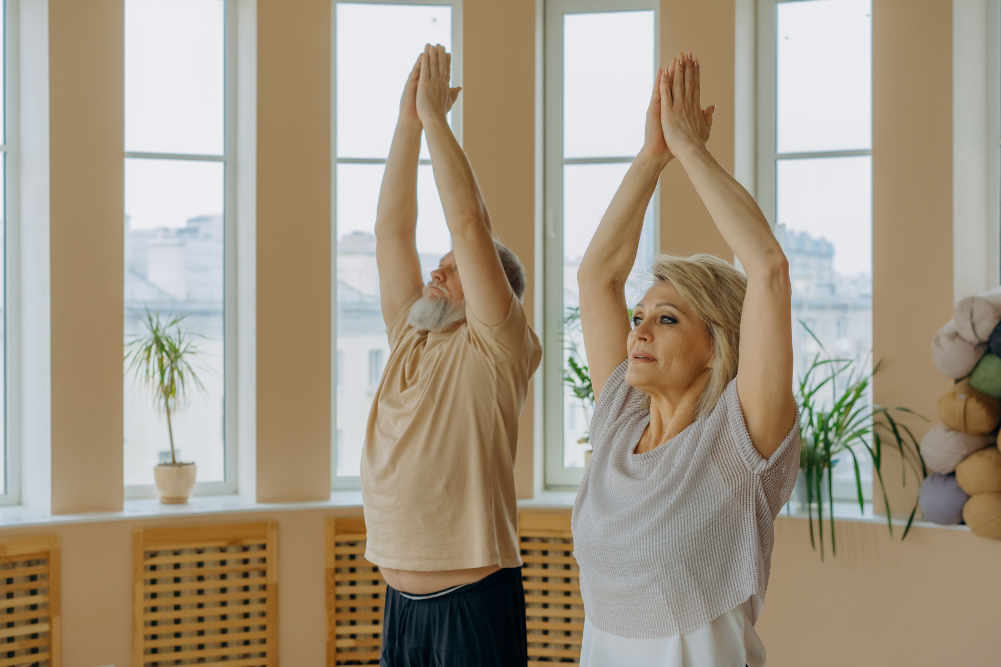
The whole sequence below can be done seated, standing, or a mix of both. Move at your own pace.
Diaphragmatic breath
Imagine there is a jellyfish in a dome shape, sitting above your navel. As you inhale, keep your shoulders and belly relaxed but allow them to open, expanding the ribs and floating down to the softness of the lower belly. As you exhale, it floats back up, into its thinner dome form. Do this a few times, in and out through the nose.
Bhramari (bee humming breath)
Close your eyes. Take a slow, expansive jellyfish breath in; as you exhale, make a humming sound all the way to the end of the exhale. Repeat for five rounds and notice how you feel at the end.
Gentle rhythmic movement
Move from a bed, chair or supported seat, or stand if you have the capacity. Lift the arms on an inhale and lower them on an exhale, as a modified sun salute. Small, slow turns or nods of the head help release neck tension. Roll the shoulders up to the ears and slide the shoulder blades down the back to bring circulation into the upper body. Extend one leg at a time, flex and point the foot, then rotate it in small circles.
Tadasana (mountain)
If seated, open the chest, broaden the collarbones, draw the shoulders back and imagine a piece of string drawing the crown of the head up to the sky. If standing, set the feet hip-width or a little wider, hips over knees, shoulders over hips. Ground the four corners of the feet down and take a few rounds of breath.
Wall plank
From tadasana, extend the arms and press the hands into a wall. Take a few rounds of breath, focusing on the exhale connecting to the core muscles.
Sphinx
From tadasana, place the forearms on the wall and climb the sternum up. Option to lie on the belly, press the forearms down and lift the chest.
Seated twist
Seated twists are better suited to older bodies. From your seat, gently twist the upper body to the right, keeping the lower back stable, lifting the chest and broadening the collarbones. Take a few breaths and switch sides.
Cat-cow
Place hands on thighs or a wall in front of you. On the inhale, open the chest and slide the shoulder blades down the back; on the exhale, reverse, press the wall away and round the upper back.
Side stretch or chair trikonasana
Reach the left arm overhead and stretch over to the right for a few breaths, then swap. Option to step the left foot back, take the right hand to a chair and reach the left arm out in a t-shape for a modified trikonasana.
Supported forward fold or downward dog
Place hands or elbows on thighs for a supported seated forward fold. If standing, place hands on a chair or wall to maintain length in the spine.
Balance or tree pose
Holding onto a chair or wall, press down through the right foot, come onto the left toe tips and shift the weight into the right foot. Stay here, or turn the knee out to the side, keeping the hips even. Take a few breaths and swap.
Modified legs up the wall
Lie on the floor, with blankets and support if you need, and place calves on a chair. Take five to 10 slow breaths, focusing on the diaphragmatic breath.
Butterfly
From a seat on the floor or blankets, take the soles of the feet together and let the knees fall out to the side. Take a few slow breaths, keeping the spine extended or gently folding forward.
Savasana with mindfulness and gratitude
Sit quietly or lie down with the eyes closed and allow the body to integrate. When ready, listen to sounds around you, feel sensations on the body, take in the smells of the room and the taste on the tongue, and observe the breath. Off er gratitude for each precious breath, for your family or friends, or anything you wish to be grateful for today.
This article is featured in WellBeing Magazine 224